The Sunset Arbitrage: Pricing Paradise by the Minute
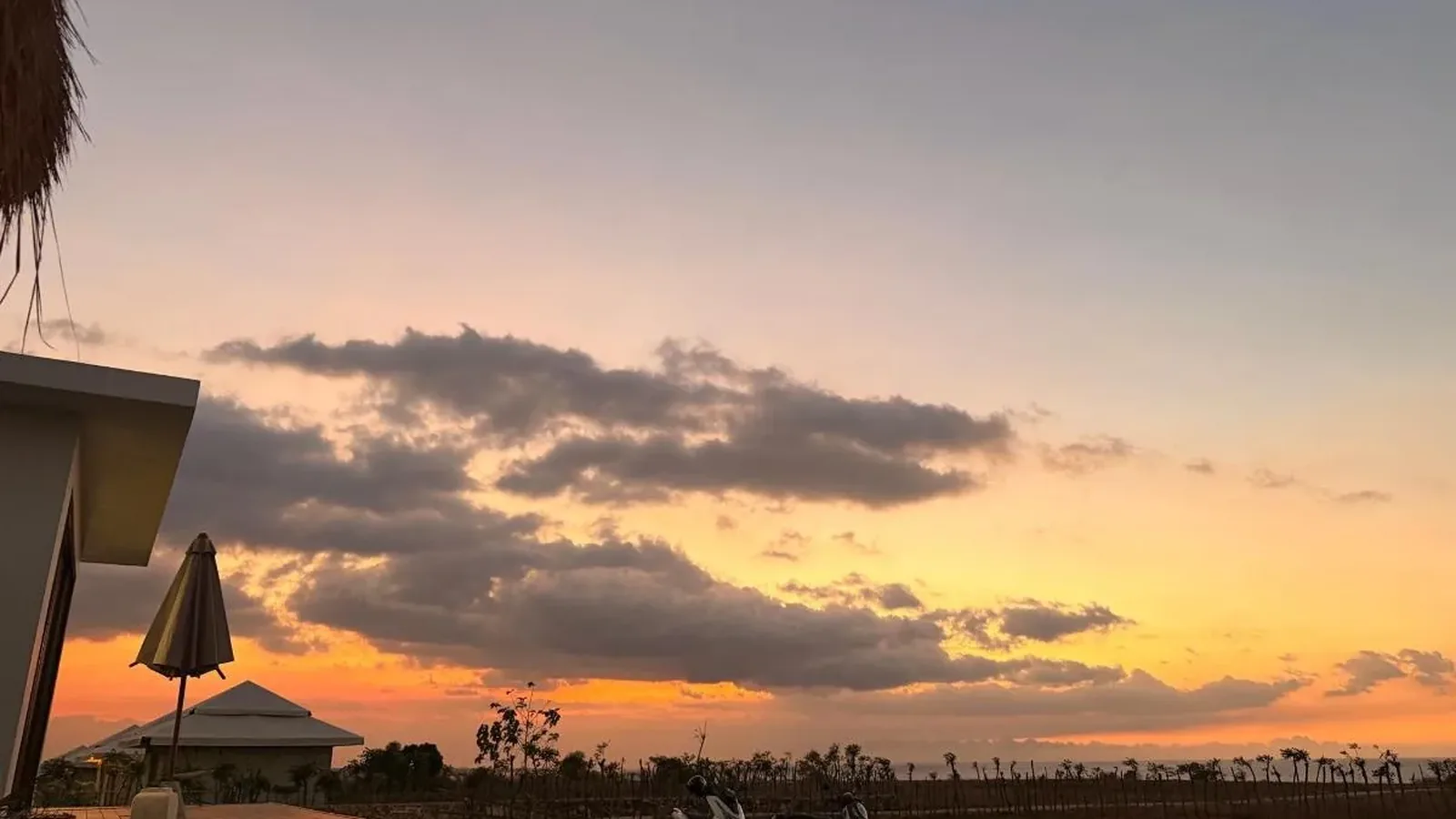
The spreadsheet said one thing. The salt air, thick with the scent of clove cigarettes and overpriced perfume, said another. It was 6:17 PM. A molten disk of sun was kissing the Indian Ocean, a daily performance of such profound beauty it seems almost vulgar to put a price on it. But here, in a front-row daybed perched above the churning surf of Canggu, pricing it is the entire point.
A French tourist, phone in one hand to capture the spectacle, scanned a QR code with the other. A flick of his thumb approved a minimum spend of IDR 3,000,000—just over $180—for the privilege of this specific wicker throne. The transaction was frictionless, timed perfectly as the DJ’s ambient track swelled to a crescendo. The sun dissolved. The sky flared magenta. The deal was done.
Below his perch, a young Balinese waiter, his own view of the horizon entirely obscured by the multi-level scaffolding of capitalism built to sell it, began the Sisyphean task of clearing a mountain of empty Bintang bottles and half-eaten tuna tartare. He doesn’t own the view. He services it. Up and down the coast, in a thousand similar venues, the same transaction was being completed. The archipelago’s most reliable, liquid, and spectacular asset was being sold off, one 90-minute slot at a time.
The Sunset-Industrial Complex: Engineering Scarcity
One does not simply watch the sunset in South Bali anymore. One consumes it. The sprawling beach clubs that dominate the coastline from Seminyak to Uluwatu have become masters of financial alchemy, transforming a public good into a tiered, high-yield luxury product. They aren't in the food and beverage business. They are in the sunset business. Food and beverage is merely the currency of the transaction.
The business model is a masterclass in engineered scarcity. Consider the architecture: vast, multi-level structures designed not for comfort, but for the optimal stratification of sightlines. The most valuable real estate is not the plot of land itself, but the 1.5-meter-wide strip of cushioned daybeds directly fronting the ocean. Here, the 'minimum spend' is king. At a premier venue in Canggu, that sunset-fronting 'VIP Daybed' requires a commitment of IDR 2,000,000, roughly $125. A less desirable seat, just a few meters back with a view partially obscured by the influencer in front of you, might only be IDR 500,000. That’s a 400% premium for a few unobstructed degrees of horizon.
“We don’t see it as a restaurant with a view,” a general manager for one of the largest beach club groups told me, on condition of anonymity. “We see the sunset as a 90-minute theatrical performance with two showtimes a year—dry season and wet season. Our job is to sell every seat at the optimal price point. We have algorithms that track booking velocity against weather forecasts. We calculate revenue-per-sunset-minute.”
This is a far cry from a sarong on the sand. The operation is powered by a zero-cost marketing engine of formidable power: Instagram. Every photo posted from a daybed, cocktail perfectly silhouetted against the orange sky, is an unpaid advertisement that drives a self-perpetuating cycle of demand. The club doesn’t need to sell the sunset; its customers do, creating a feedback loop that continually inflates the perceived value of a front-row seat. Mobile data analytics firms have noted a measurable 30-40% spike in network upload traffic in Bali’s tourist hubs between 6:15 PM and 6:45 PM. It's a daily, predictable bandwidth crunch, a digital signature of mass-produced awe. The Indonesian concept of jam karet, or 'rubber time'—that wonderfully relaxed attitude to punctuality—evaporates for this celestial deadline. The sunset has become the one appointment in Bali that everyone keeps.
The View Premium: How Sunsets Redraw the Real Estate Map
The commodification of the horizon extends far beyond the daybed. It is fundamentally reshaping the physical and financial landscape of the island itself. The 'sunset premium' is now the single most important variable in the valuation of land in southern Bali, creating distortions that would seem absurd in any other market.
Nowhere is this more apparent than on the limestone cliffs of the Bukit Peninsula, in areas like Uluwatu and Pecatu. Here, two plots of land, identical in size and topography, can have vastly different values based on a single, ephemeral quality: an unobstructed, west-facing view of the ocean. According to data from local real estate agencies, a plot of land with such a view commands an average price of $1,500 USD per are (100 square meters) on a long-term lease. Move just 500 meters inland, losing that direct line of sight to the evening's main event, and the price plummets to $800 per are. That 87.5% markup is the market's price for the sunset.
This premium is rewiring investment strategies. A decade ago, foreign investment focused on proximity to amenities. Now, it chases the view. I spoke with a French real estate agent who now sells almost exclusively to European family offices. His primary sales tool is a DJI Mavic drone. “I don’t sell land,” he explained, sipping an espresso in his chic Berawa office. “I sell a feeling. We schedule the drone flight for 6:00 PM. I fly it from the boundary of the plot, out over the cliff, and turn it back towards the land, with the sun setting perfectly behind it. I send that five-minute video to a client in Zurich or Paris. They see the villa they could build. They see the infinity pool reflecting the sky. The deal is usually closed within 48 hours.”
The financial comparison is stark:
- Amsterdam (Jordaan): €350,000 buys a 45-square-meter apartment. The primary asset is location within a historic city.
- Uluwatu (Cliff-front): €350,000 secures the 25-year leasehold (Hak Sewa) on a 500-square-meter plot of land. The primary asset is a guaranteed, unobstructed, and highly monetizable daily solar performance.
This dynamic has created a new class of property funds that treat 'guaranteed sunset view' plots like blue-chip stocks. They acquire leases, bundle them into investment vehicles, and sell shares to investors who may never set foot in Indonesia. They're betting that as long as the sun continues to set in the west, their asset will appreciate. It's a logic that feels both unassailable and terrifyingly fragile.
Gili Trawangan: The Backpacker’s Sunset IPO
If Bali’s south represents the sophisticated, high-finance end of the sunset market, Gili Trawangan is its scrappy, unregulated initial public offering. This tiny island off the coast of Lombok offers a perfect case study in how a public good transitions to a privately captured, saturated market.
Twenty years ago, watching the sunset on Gili T's western shore was a simple affair. You found a patch of sand, perhaps bought a warm Bintang from a man with a cooler, and watched. It was a communal experience, shared by a handful of backpackers and local fishermen. The asset was free to all.
Then came the beanbags. One bar put out a few, offering a more comfortable way to enjoy the show. It was a hit. Soon, every establishment followed suit. The free sand began to disappear beneath a sea of brightly coloured polyester. This was the first stage of commodification. The price of the sunset became the price of a drink. By 2010, there were fewer than ten modest businesses dotted along the 2-kilometer 'sunset strip'. By 2023, that number had exploded to over 45, a 350% increase in commercial density.
As competition intensified, a gimmick arms race began. One entrepreneur built a simple wooden swing in the shallows. The image of a lone figure swinging against a fiery sky was photogenic catnip. The 'swing queue' was born. On a typical evening now, tourists wait up to 20 minutes for their 60-second turn on the swing, a transaction that requires the purchase of an overpriced cocktail. There are now dozens of such swings, hammocks, and picture frames, each a miniature tollbooth on the road to the perfect Instagram post. The sunset itself has become almost secondary to the act of documenting oneself within it.
This is a classic market evolution: low barriers to entry lead to a rush of participants, which leads to saturation, price wars, and a frantic search for differentiation through gimmicks. The sunset, once an experience of quiet contemplation, has been 'IPO'd' to the masses. Everyone can buy a small share, but the frenzy of the trading floor has drowned out the value of the underlying asset. It feels less like watching nature and more like participating in a low-stakes, real-time auction for social media validation.
The Komodo Fleet Market: Pricing a Mobile Sunset
What happens when the asset isn’t fixed to a specific piece of land? The liveaboard boat economy in Komodo National Park provides an answer. Here, the sunset is a key feature of a multi-day package, a product that is mobile, curated, and subject to extreme price segmentation.
The core product is remarkably consistent: a 3-day, 2-night boat trip through the spectacular islands of the park, seeing dragons, snorkeling with manta rays, and hiking to viewpoints. Yet, the price for this experience ranges from $150 for a 'backpacker' boat to over $2,500 per person for a luxury phinisi—a traditional Indonesian two-masted sailing ship. The itinerary is nearly identical. That staggering $2,350 difference is a study in the economics of experience.
On the $150 boat, you sleep on a mattress on the deck. The sunset is watched from a plastic chair while eating a communal meal of fried rice. On the $2,500 boat, you retire to an air-conditioned cabin with an ensuite bathroom. The sunset is watched from a linen-draped daybed as a steward serves you champagne and canapés. A professional photographer on board may even offer to capture the moment with a drone. It is the same sun, the same sky. But the perceived value, and the price, are worlds apart.
Nowhere is this clearer than at the nightly spectacle of Kalong Island. At dusk, hundreds of thousands of giant fruit bats—flying foxes, or kalong—emerge from the mangrove island, streaming across the twilight sky. It’s a breathtaking natural event. Each evening, the channel facing the island becomes a floating parking lot of dozens of tour boats, all jockeying for the prime viewing position.
“It’s the most stressful thirty minutes of my day,” one captain of a mid-range boat confided in me as he maneuvered his 30-meter vessel between a budget boat blasting reggae and a silent luxury phinisi. “The wind, the current, the other boats… everyone wants the perfect shot. The guests on the cheap boats are happy just to see it. My guests paid $1,000 a night. They expect the bats to fly right over their heads while they sip their Negronis. My entire tip depends on where I park the boat for fifteen minutes.”
This is the sunset as a logistical challenge. The value is captured not by owning the land, but by controlling the vessel that provides the best access at the precise moment. It’s a market that bears a faint, unsettling resemblance to the Dutch tulip mania of the 17th century—a feverish pursuit of a beautiful, ephemeral thing whose perceived value has become detached from its intrinsic worth.
The State-Mandated Sunset: Raja Ampat’s Conservation Levy
If Gili Trawangan is a chaotic free market and Komodo a tiered service economy, Raja Ampat represents a third model: the state-managed monopoly. In this remote archipelago off the coast of West Papua, often cited as the global epicenter of marine biodiversity, the sunset is not cheap. In fact, its price is explicitly stated before you even arrive.
To enter the region, every foreign tourist must purchase a Marine Park Entry Permit, known as a PIN. The cost is IDR 1,000,000 (about $65) and is valid for one year. This fee, coupled with the high cost and logistical difficulty of simply getting there, acts as a powerful economic barrier. It is a deliberate strategy of pricing-in the externality of tourism. The sunset here is not a loss leader for cocktails; its preservation is part of the upfront cost of admission.
| Location | Sunset Access Model | Primary Cost | Barrier to Entry | Perceived Experience |
|---|---|---|---|---|
| Canggu, Bali | Private Commodification | Minimum Spend ($125+) | Low (Financial) | Social, Performative |
| Gili Trawangan | Saturated Free Market | Price of a Drink (~$5) | Very Low | Crowded, Gimmicky |
| Komodo NP | Tiered Service | Boat Package ($150-$2,500+) | Moderate | Curated, Segmented |
| Raja Ampat | State-Managed Exclusivity | Park Permit ($65) + Travel | High (Financial, Logistical) | Exclusive, Quiet |
Does it work? On the surface, yes. A sunset from the top of Pianemo, looking out over the iconic karst islets, is a profoundly different experience from its Balinese counterpart. You might share the view with a dozen other people, not a thousand. The silence is broken only by the cry of birds, not a DJ set. This is the peace that money can buy.
But the model is not without its critics. Official figures are hard to come by, but estimates suggest that as little as 60% of the revenue from the PIN fees is directly reinvested into conservation and community programs. The rest is absorbed by administrative overheads, a familiar story in Indonesian public finance. The high barrier to entry has effectively turned one of the world's greatest natural treasures into a playground for the wealthy. It protects the environment from the masses, but it also excludes them. The question lingers in the quiet air: is this genuine conservation, or simply a mechanism to create an exclusive, high-priced product for a global elite? Is this peace, or just expensive emptiness?
The Sumba Signal: Philanthropy as a Moat
There exists a level beyond the state-managed exclusivity of Raja Ampat. It’s a place where the sunset is so private, so perfectly curated, that it approaches the status of a bespoke art installation. Welcome to Sumba.
On this wild, arid island east of Bali, the resort of Nihi Sumba has perfected the art of ultimate scarcity. Voted 'best hotel in the world' multiple times, it has built a formidable moat around its product, and the sunset is a cornerstone of that defense. The price is the first line of defense: rooms start at around $1,600 per night. This alone ensures that the resort's 2.5 kilometers of private beach will never be crowded. The average daily income on Sumba island, for context, is less than $3. This represents a staggering 53,000% income disparity between the guest watching the sunset and the local villager outside the resort's walls.
But the true genius of the Nihi model lies in its integration of philanthropy. The resort is the primary benefactor of the Sumba Foundation, a genuinely impactful organization that has done remarkable work in providing clean water, education, and healthcare to the local community. This is not just corporate social responsibility; it is a core part of the business model. It allows the ultra-wealthy guest to neutralize the cognitive dissonance of spending thousands per night in a region of profound poverty.
“We are entering an era of post-luxury,” a leading hospitality analyst told me. “The new currency for the ultra-high-net-worth individual isn’t just exclusivity, it’s purpose. Nihi doesn’t just sell you a private sunset; it sells you a virtuous one. The high price tag isn’t just buying privacy; it’s funding a clinic. It transforms a selfish indulgence into a selfless act. The sunset becomes a moral asset.”
This is the final turn of the screw in the commodification of nature. First, you charge for the view. Then, you charge for the service that enhances the view. Finally, you charge for the moral justification of having paid for the view in the first place. Philanthropy becomes a marketing tool and a competitive advantage, ensuring that no competitor can easily replicate the product. The sunset at Nihi is not just beautiful; it’s unimpeachable.
The Unmonetized Frontier: Arbitrage in the Banda Islands
Is there anywhere left in this archipelago where a sunset is just a sunset? For now, yes. The answer lies in places where the market has not yet arrived, where the price of the view is not paid in cash, but in effort. Welcome to the Banda Islands, the fabled Spice Islands of antiquity, deep in the Banda Sea.
This is a pre-market environment. The sunset here, watched from the waterfront of Banda Neira as it silhouettes the perfect cone of the Gunung Api volcano, is spectacular. Its 'price,' however, is not monetary but logistical. A one-way journey from Jakarta can involve multiple flights, an overnight ferry, and cost upwards of $350, taking anywhere from 24 to 48 hours. This friction is a natural barrier to mass tourism. But once you arrive, the local economy is startlingly affordable. A clean room in a family-run guesthouse costs $20 a night, breakfast included. The sunset is free.
This is a classic arbitrage opportunity. The perceived value of the experience—a historic, stunningly beautiful, and uncrowded sunset—is extraordinarily high. The direct, on-the-ground cost is exceptionally low. The difference between the two is the arbitrage gap. An economist sees this gap and knows one thing: the market will eventually close it. Someone will build a faster ferry. An airline will add a direct flight. A developer will buy the best plot of waterfront land and build a boutique hotel. The price will begin to rise.
For now, though, the evenings in Banda Neira offer a glimpse of what Bali might have been like fifty years ago. As the sky turns orange, the waterfront comes alive not with tourists, but with the community. Fishermen mend their nets, children play football, and old men sit on stone walls, talking. The few travelers who have made the journey sit among them, sharing the same view, for the same price: nothing. This is the value of the unmonetized frontier. It’s a snapshot in time, and like all such snapshots, it is destined to fade. It was in this very archipelago that the 1883 eruption of Krakatoa threw so much particulate matter into the sky that it created brilliant sunsets globally for years, profoundly influencing Western art. The world has been trying to price an Indonesian sunset ever since.
The Externality Horizon: When the Asset Degrades
There is a flaw at the heart of the sunset economy. The sun itself is a perfectly reliable, infinite asset. It will rise and set with dependable precision long after the last beach club has crumbled into the sea. But the experience of the sunset is not infinite. It depends entirely on a finite set of underlying assets: the land, the coastline, the clarity of the air, the health of the reef, and the local culture that gives a place its soul. And these assets are being rapidly degraded by the very economic engine built to exploit them.
This is the dark calculus of negative externalities. In Canggu, the 5-kilometer stretch of beach clubs that so efficiently monetizes the sunset also collectively generates an estimated 3 metric tons of waste—plastic, glass, food—every single day during peak season. The infrastructure required to support these venues strains local water supplies and overwhelms waste management systems. The noise and light pollution drive away wildlife. The endless construction turns quiet rice paddies into noisy building sites.
The cultural cost is just as high. I spoke with a village elder in Pererenan, a community just north of Canggu that is the next frontier for development. His family has lived there for generations. “The beach was our place,” he said, his voice heavy. “For ceremonies, for fishing, for our children to play. Now, there are walls. We see the concrete going up. Soon, to go to our own beach, we will have to walk through a hotel lobby. They are selling our sunset back to us.”
The paradox is cruel. The more economic value that is extracted from the 'sunset product,' the more the underlying natural and cultural capital is eroded. Each new beach club that opens slightly diminishes the quality of the tranquility it aims to sell. Each cliff-top villa that is built adds to the light pollution that dulls the stars that follow the dusk. The market is, in effect, consuming its own foundation. The pursuit of maximizing revenue-per-sunset-minute is actively shortening the lifespan of the market itself.
The final glow disappears from the horizon, and the transaction is complete. Phones are pocketed. Bills are settled. The staff, paid a fraction of the minimum spends they’ve collected, begin their nightly work. The sun, that perfectly reliable asset, will be back in 24 hours to perform again. The real question is whether the economic model built on its back is a sustainable investment, or just another speculative bubble, whose eventual burst will leave more than just broken glass on the sand.