The Sea's Slow Exhale: Sumba's Fading Dialogue
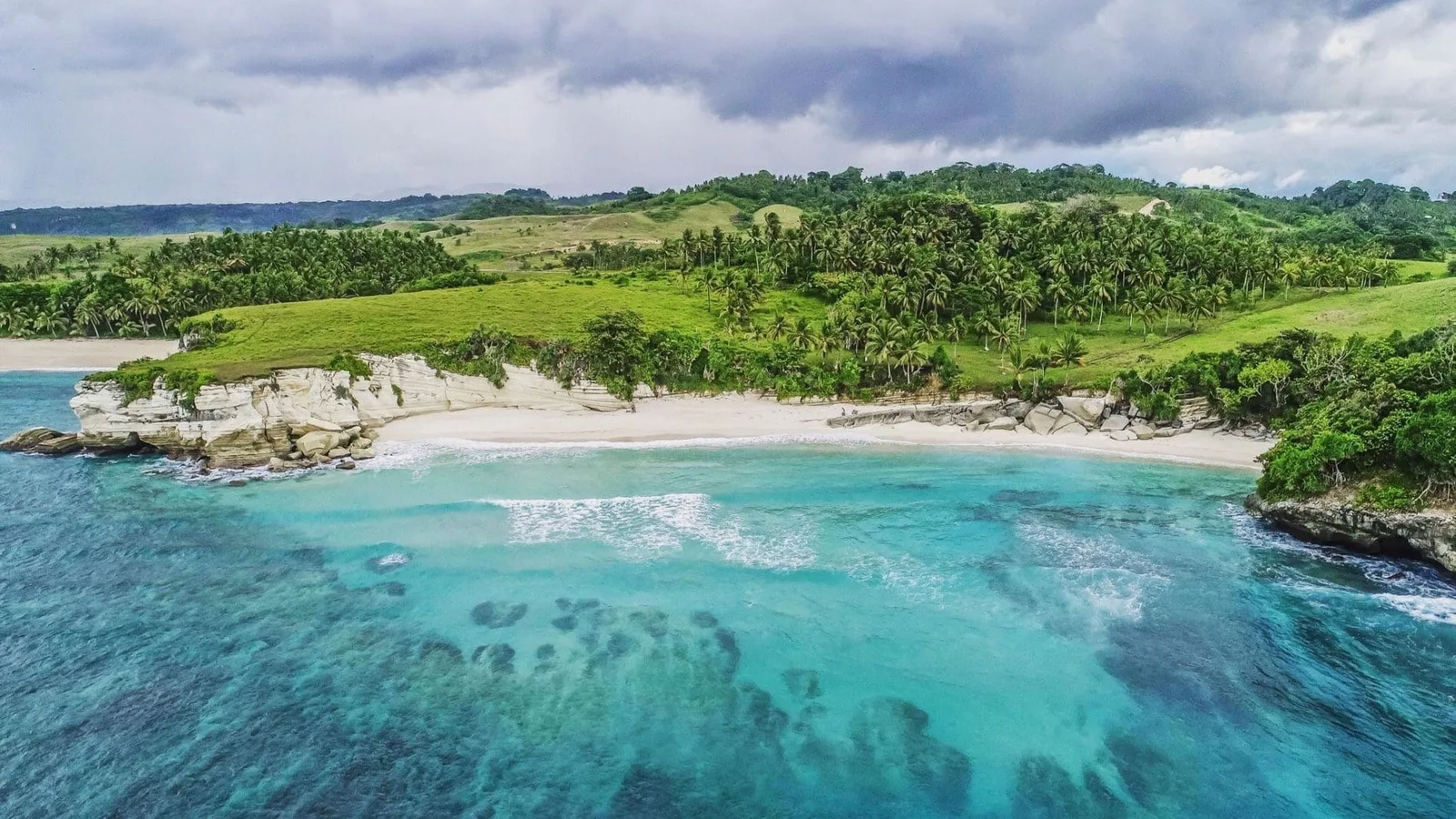
There’s a particular quality to noon light at ten degrees south of the equator. It doesn't slant or dapple; it arrives with the vertical, unblinking intensity of a judgment. It bleaches the color from the limestone cliffs and presses down on the sea, turning the surface into a sheet of hammered silver that hurts the eyes. The world above the water is a world of heat and glare, of cicadas humming themselves into a frenzy in the dry scrub.
From the outrigger of his weathered perahu, Yulianus observes this world for a moment, his face a mask of concentration carved from teak. He makes no overture, no prayer, not yet. This is the moment of calibration, of aligning the rhythm of his own blood with the slow, deep pulse of the ocean beneath him. He is a man caught between two worlds, the blinding one of air and the silent one of water, and his life is a continuous translation between them.
Then he moves. There is no splash, only a quiet parting of the water, a seamless entry as if the sea were a membrane he has been passing through his entire life. He doesn't plunge, but rather pours himself into the blue. The hard line of the horizon vanishes, the shriek of the cicadas is replaced by the muffled thrum of his own heart. Below him, a world of impossible turquoise and sapphire unfolds, a city of coral bommies and fleeting, silver-skinned shadows. He has carried with him a single, finite column of air, a gift from the world above to be spent wisely in the kingdom below.
I. The Salt-Stung Invocation
Silence is the first gift of the drop. Not an absence of sound, but a new kind of sound: the internal, percussive beat of your own existence, the faint fizz of oxygen metabolizing in your veins. For Yulianus, this silence is a language. He has been speaking it for thirty of his forty-two years. He descends without the aid of fins, his bare feet making small, efficient sculling motions, a technique passed down from his father that moves him through the water with the stealth of a predator, not the clumsy propulsion of a visitor. This is not the measured, gear-heavy descent of a recreational diver, but a salt-stung invocation, an entry into a sacred space.
His equipment is an extension of his body, an archive of his skill. The goggles are his own creation, hand-carved from wood, the single pane of glass scavenged from a broken window and sealed into the frame with a black, sticky tar that still smells faintly of smoke. They press tight against his eye sockets, a familiar, almost comforting pressure. His speargun is also teak, heavy and balanced in his hand, its single rubber band worn smooth with use. He paid a friend 150,000 rupiah, about ten dollars, for the trigger mechanism, the only part he couldn't forge himself. Everything else—the stock, the spear, the precisely braided line—is the work of his own hands, shaped during the windy nights when the sea is too rough to hunt.
He drifts down, a mote in the vast, blue cathedral. During the dry season months from May to September, the visibility in these waters can exceed thirty meters, a dizzying clarity that can induce a kind of vertigo in the uninitiated. You feel as if you are flying, suspended over a landscape of impossible architecture. Yulianus feels not vertigo, but belonging. The physical discipline of the breath-hold is second nature, a capacity built not in a weekend freediving course with certificates and lanyards, but over a lifetime of daily practice. It began with diving for shells in the shallows as a boy, his lungs burning, his father watching from the shore, teaching him to relax, to surrender, to make a single lungful of air last an eternity. It's a muscular memory, a cellular knowledge. It's the price of admission.
II. A Lexicon Written in Coral
The reef below is not just a landscape to Yulianus; it is a text, a lexicon written in coral and current that he has spent his life learning to read. A tourist sees a beautiful, chaotic jumble of color and form. Yulianus sees a grammar of survival. He knows, for instance, that the fruiting of the kenari tree on the cliffs above signals a change in the currents that will bring schools of fusiliers to the reef's edge. He knows that a certain slickness on the water's surface at dawn, invisible to most, means the trevally will be hunting aggressively. This indigenous ecological knowledge, a tapestry of terrestrial and marine cues, is a science far older than the satellite data that now tries to predict the ocean's moods.
"The reef tells you everything," he explained to me later, sitting on the floor of his simple home, mending a fishing net. "But you have to learn to listen. The foreigners come with their fish finders, their machines. The machine tells them where the fish are today. The reef tells me where the fish will be tomorrow."
Each species requires a different dialect. Hunting a Coral Trout (Plectropomus leopardus), the prized, crimson-spotted fish known locally as kerapu sunu, is an exercise in patience. It requires a slow, silent approach, hugging the reef's contours, peering into the dark ledges and overhangs where they lurk. He becomes part of the reef, another shadow among shadows, waiting for the fish to accept his presence. Hunting a Giant Trevally (Caranx ignobilis), or ikan GT, is the opposite. It is a game of explosive speed and anticipation, predicting the trajectory of a silver torpedo moving at fifty kilometers an hour. He must position himself not where the fish is, but where it will be in three seconds, a complex calculation of angle, speed, and instinct.
A master fisherman like Yulianus can identify over fifty distinct types of coral formations and knows the specific fish species each is likely to shelter. He inherited this library of knowledge. He tells me a story of his grandfather, a man who hunted these same waters with a spear carved from a single piece of bamboo. "My grandfather showed me how to watch the small, blue fish, the cleaner wrasse," he says, his eyes focused on a distant point in the past. "They are the doctors of the reef. Where they gather, a big fish is nearby, waiting to be cleaned. A grouper, maybe a lazy one, hiding deep in a cave. You follow the doctor, you find the patient." This secret, this simple observation, is a thread of knowledge passed through generations, worth more than any piece of technology.
III. The Spear and the Spirit
To understand the hunt is to understand that for Yulianus, the spear is not merely a tool and the fish is not merely protein. The act of spearfishing is deeply entwined with the animist beliefs of Marapu, the ancestral religion that still holds profound sway here. Unlike much of Indonesia, which saw centuries of Hindu, Buddhist, and later Islamic influence, Sumba remained isolated, a cultural island within an archipelago. This allowed its indigenous belief system to persist with a unique potency. Today, up to 30% of the island's population still actively practices Marapu, a spiritual cosmology where the natural world is alive with spirits, and balance is the cardinal virtue.
The sea, in the Marapu worldview, is the domain of powerful spirits, the marapu of the deep. They are the guardians of the reef's abundance, and they do not give up their bounty lightly. To enter their world without permission, to take without asking, is to invite misfortune—a lost spear, a sudden cramp, a dangerous current that pulls you out to the open ocean. This is why the hunt for Yulianus begins not at the water's edge, but on the land. Before we left, I watched him walk to a rocky outcrop overlooking the bay. He took from a small woven pouch a piece of betel nut and a pinch of rice, placing them carefully on the sun-warmed stone. His lips moved, but the words were a low murmur, carried away by the wind—a request for safe passage, for a clear eye, and for the sea to offer a gift for his family. It was not a prayer of domination, but of negotiation.
This belief system codifies a sustainable practice. The core tenet is to take only what is needed for the family to eat or to sell for immediate needs. Taking more is seen as greedy and disrespectful, an act that will anger the spirits and diminish future catches. There is no concept of a 'trophy'. A large fish is a sign of the sea's generosity, a blessing to be shared with the village, not a personal achievement to be mounted on a wall. The bones of a significant catch are often returned to the sea in a gesture of gratitude, completing the circle. This spiritual framework creates an innate conservation ethic, a system of checks and balances that has maintained the reef's health for centuries, long before the language of 'sustainability' entered the global lexicon.
IV. Carbon Fins on an Ancestral Reef
The conversation with the sea is being interrupted by a new, louder dialect. It arrived on airplanes, packed in long, padded bags. It speaks in the language of carbon fiber, neodymium magnets, and GoPro mounts. The arrival of high-tech spearfishing as a sport for tourists and a growing number of foreign residents has introduced a profound cultural and technological dissonance on the reef. Where Yulianus drifts with the quiet efficiency of a leopard seal, these new hunters power through the water with long, powerful carbon fins, their movements amplified, their range extended.
Suddenly, Yulianus's world, once governed by the limits of his own lungs and the power of his own muscles, is being measured against a new, alien standard. The clash is stark. For Yulianus, spearfishing is sustenance, a dialogue, a spiritual practice. For many of the newcomers, it is a sport, an adrenaline-fueled pursuit of personal bests and 'trophy shots'. Their language is of depth records, kill lists, and the 'thrill of the hunt,' a vocabulary that sounds jarring and violent in the context of Marapu's quiet reverence. They are not negotiating with the sea; they are conquering it.
I spoke with a visiting South African, staying at a luxury resort down the coast, a man kitted out with thousands of dollars of the latest gear. "It's the ultimate challenge, mate," he told me, his face glowing with sun and excitement. "Pitting yourself against a big dogtooth tuna in blue water. Last year my personal best was 40 kilos. This year I'm hoping for 50." He spoke of the fish as an adversary, an opponent in a game.
This new reality presents a quiet, powerful temptation. Local fishermen see the efficiency of this modern gear. A multi-banded, roller-powered speargun can shoot farther and with more power than Yulianus's simple teak gun, allowing the hunter to take fish from a greater distance, without needing the same level of stealth and patience. But the economic barrier is immense, a veritable wall between two worlds.
- Traditional Wooden Speargun (local): Approx. 150,000 IDR ($10 USD) to make.
- Imported Carbon Fiber Speargun (foreign): 15,000,000 IDR ($1,000 USD) or more.
This hundredfold price difference is not just a gap; it's a chasm. It means the old ways are not just a choice, but for many, a necessity. Yet, the desire for the new tools, and the efficiency they promise, puts a subtle pressure on the foundations of the traditional practice. The conversation is no longer just with the sea, but with the seductive, metallic whisper of modernity.
V. The Ledger of the Catch
The journey of a fish from spear tip to dinner plate tells a story of two Sumbas, a tale of diverging economic realities that are reshaping the reef itself. When Yulianus returns from the sea with a good catch—a few reef fish, a decent-sized snapper, perhaps a coveted coral trout—the fish enters a complex local economy. His wife, Maria, takes the smaller fish and any surplus to the bustling morning market in Waikabubak. It is a chaotic, sensory riot: the wet slap of fish on wooden tables, the sharp cries of sellers, the glint of scales under bare fluorescent bulbs, the thick, metallic smell of the ocean's bounty mingling with diesel fumes from the street. Here, amidst the haggling and camaraderie, a kilogram of fish might fetch 30,000 IDR, maybe 40,000 if it's a good day. It's enough for rice, for cooking oil, for their children's school fees.
But a new, far more lucrative channel has opened up. The luxury resorts that have begun to dot the coastline, offering European high-design and infinity pools to a global elite, have voracious appetites for pristine, local seafood. The executive chefs at these establishments, some of whom have worked in Michelin-starred kitchens in Paris or Sydney, will pay a premium for the best of the catch, delivered fresh to their kitchen doors. This creates a powerful economic pull, a gravitational force that is subtly altering the ancient rhythms of the hunt. The financial comparison is staggering. A top-tier resort villa might go for €25,000 for a one-week stay—more than thirty-five times the island's average annual per capita income of approximately €700. In that context, paying a premium for fish is a rounding error for the resort, but a life-changing windfall for the fisherman.
| Fish Destination | Price for 2kg Coral Trout | Economic Logic |
|---|---|---|
| Local Waikabubak Market | ~160,000 IDR (~$10) | Sustenance, community, daily cash |
| Direct to Luxury Resort Kitchen | ~500,000 IDR (~$32) | Export-quality, luxury commodity |
This price differential—more than triple the local market rate—is impossible to ignore. It incentivizes fishermen to specifically target the 'resort menu' fish: coral trout, snapper, grouper, and lobster. They become suppliers in a global luxury supply chain. The traditional, more diverse fishing pattern, which targeted a wider variety of species and spread pressure across the ecosystem, is being replaced by a focused, high-intensity hunt for a few select species. Yulianus now finds himself thinking not just of what his family needs, but what the resort chef wants. The ledger of the catch is being rewritten, and the new math, while profitable, carries a hidden ecological cost.
VI. The Unheard Warnings
Beyond the visible pressures of new money and modern gear, a quieter, more insidious change is taking place. The lexicon of the reef, which Yulianus reads with such fluency, is being erased. The very pages are dissolving. Climate change is not an abstract political debate here; it is a ghost haunting the reef.
One afternoon, Yulianus takes me in his perahu to a place he calls 'Batu Putih'—the white rock. It's not a rock, but a sprawling section of reef. He remembers it from his youth as a garden of impossible color, a place where staghorn and table corals grew in thickets of blue, pink, and yellow. Now, it is a graveyard. A ghostly white expanse of coral skeletons stretches out beneath us, the aftermath of a severe bleaching event a few years prior. He points a finger, his face grim. "Here, there were many small fish, hiding. Now, nothing. The house is broken, so the family has left." Scientific surveys confirm his observation: coral cover in the Savu Sea Marine National Park, which surrounds these shores, has declined by nearly 15% in the last decade alone due to repeated, heat-induced bleaching events. The water is warming, and the coral, the very foundation of this world, is dying.
He speaks of other changes, subtle shifts in the ancient dialogue. The currents are less predictable. The monsoon winds arrive later, or with more fury. The fish are fewer, and smaller. This isn't just the lament of an old man; it's the observation of a scientist whose laboratory is the sea. These local changes are compounded by distant, invisible forces. Massive industrial fishing fleets, often operating illegally on the peripheries of Indonesian waters, use vast nets to scoop up entire schools of tuna and other pelagic species. Their colossal catches deplete the stocks that would otherwise migrate through these waters, leaving a profound emptiness in the blue water beyond the reef. The loss of Sumba’s mangrove forests—critical nurseries for countless reef fish—to coastal development and shrimp farms further shreds the web of marine life. An estimated 40% of these vital habitats have vanished in just 25 years.
"We can be careful. We can respect the marapu," Yulianus says, his voice laced with a quiet frustration. "We can take only one fish. But the water gets hot, and the coral dies. A big ship from far away takes all the fish before they get here. What can my spear do about that?"
He is a master of a language that is being spoken into a void. He sends his questions to the sea, but the sea itself is losing its memory.
VII. The Last Echo of the Spear
The most profound threat may not be in the water at all, but in the classroom and on the screens of smartphones. The thread of knowledge, passed from grandfather to father to son, is fraying. A local village survey paints a stark picture: fewer than one in five boys under the age of fifteen are actively learning the traditional spearfishing methods from their elders. The lure of the modern world, with its promise of steadier, less demanding work, is powerful.
I speak with Yulianus's eldest son, Matius, an eighteen-year-old with a quick smile and a Liverpool football jersey. He is polite and deeply respectful of his father. He has been in the water since he was a child and knows his way around the reef. But he does not share his father's passion. His focus is elsewhere. "My father is the best. No one can read the water like him," Matius tells me, sitting on the steps of their home. "But it is a hard life. Some days you catch much, some days nothing. The sun is hot, the water can be dangerous." Matius is studying English, practicing with tourists he meets on the beach. He hopes to get a job as a surf instructor or a guest relations officer at a new hotel, perhaps a sleek project like Eco Beach City, rumored to be expanding down the coast. A steady salary, a uniform, air conditioning—these are the new aspirations. A job in tourism offers a clear path, a monthly wage, a connection to the glamorous world that arrives on planes.
The knowledge Yulianus holds is more than a set of skills; it is a worldview. It is a form of embodied intelligence, a way of being in the world. It is connected to everything. The intricate marine motifs found in Sumba's famous Ikat weavings, for example, are not just decorative. They are another form of text, encoding ancestral stories of sea journeys, mythical creatures, and even specific, legendary catches—a parallel library of marine knowledge woven in thread. When the practice of the hunt fades, the meaning of the weaving fades with it. The symbols become mere patterns, their stories lost.
This deep, physiological co-evolution with the sea, honed over countless generations, is what is at stake. Scientists studying the Bajau people of the Coral Triangle, the famed 'sea nomads,' have found genetic adaptations to their marine life, including larger spleens that act as a biological scuba tank by storing oxygenated red blood cells. While not studied to the same degree, the Sumbanese hunters represent a similar, profound symbiosis. It's a heritage of the body, a physical manuscript. When Matius chooses the surfboard over the spear, he is not just choosing a different career. He is choosing a different way for his body to know the world, and a deep, ancestral chapter is closing.
VIII. A Single Held Breath
So what is lost when a man like Yulianus is the last of his kind? It is not just the end of a picturesque tradition for tourists to photograph. It is the silencing of a conversation. The web of pressures—economic, cultural, ecological—is tightening around this ancient practice. The allure of the resort dollar pulls the hunt in one direction; the lure of a steady job pulls the next generation in another; and the slow, inexorable warming of the sea dissolves the very ground beneath them.
Yulianus becomes more than a fisherman. He is a living archive, a repository of a language that contains multitudes—a spiritual cosmology, a practical science, a physical discipline. He is a library of unwritten books. When his knowledge is no longer passed down, the library burns. What replaces it is a simpler, more transactional relationship with the ocean. The sea becomes a backdrop for a vacation, a resource to be extracted, a territory to be conquered for sport. The deep, reciprocal dialogue is replaced by a monologue.
As the sun finally begins its descent, bleeding orange and purple across the horizon, we paddle back toward the shore. The glare is gone, and the sea has turned from silver to a soft, deep indigo. Yulianus is quiet. In the bottom of the boat lies a single, iridescent parrotfish and two small snappers, a modest catch. It is enough for his family's meal tonight. It is a quiet, defiant act of cultural survival, a single coherent sentence spoken in a world of accelerating noise.
He looks not at the theatrical sunset that is drawing the cameras out at the resorts along the coast, but at the darkening water beside the boat. It is the gaze of a man listening for a reply. The silence that answers is both ancient and new, and it is impossible to know if it is a silence of peace, or of forgetting.