Sumba's Stone Ledger: An Economy of Eternity
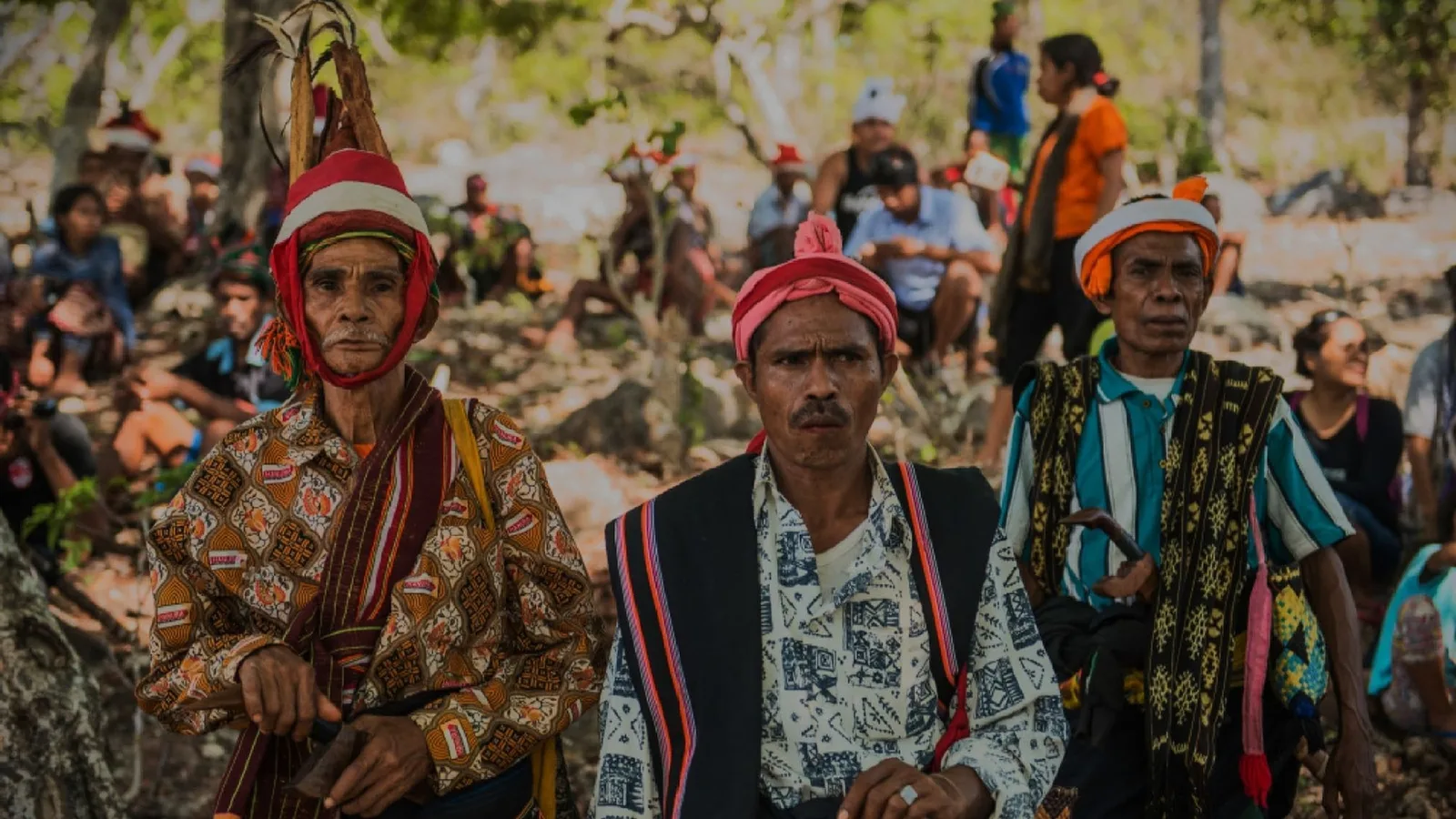
The air hangs thick with dust and the guttural chant of a hundred men. It’s a sound that seems to come from the earth itself, a rhythmic, straining exhalation that rises with the heat shimmering off the valley floor. They are pulling. Leaning into ropes of twisted vine, muscles cording on their backs, bare feet finding purchase on the cracked, thirsty ground. Their cargo is a 45-ton slab of limestone, a pale leviathan dragged not up a ramp, but across a flat expanse of sun-scorched grass.
This is not an artifact of a lost age. This is Tuesday.
The stone is a down payment on immortality. It is the capstone for a tomb belonging to a village elder who is not yet dead. He is watching, sitting in the deep shade of a bamboo and thatch hut a few hundred meters away, his face an unreadable mask of concentration. He isn't admiring the spectacle of his own future glory. He is auditing. He is noting which clans have sent their strongest men, which families pull with conviction, which of his nephews shouts the loudest encouragement. This is a ledger being written not in ink, but in sweat and sinew, a debt recorded on the communal memory that will bind his descendants for generations.
Here, eight degrees south of the equator, on an island where time seems to follow a different current, the Western spreadsheet gives way to a more profound and enduring form of accounting. The most significant, generation-defining investment isn’t in a child's education or a stock portfolio. It is in the architecture of death.
The Weight of Ancestors
To arrive in a traditional village on the island of Sumba is to walk into an inversion of Western logic. The living inhabit modest, wood-and-bamboo houses with high-peaked roofs that seem to reach for the spirits. The dead, or rather the soon-to-be-dead and the long-departed, command the center ground. The village square, the praing, isn’t a park or a marketplace; it is a forest of stone. Great dolmen-style tombs, some raw and monolithic, others intricately carved, occupy the premium real estate. They are not memorials cordoned off in a quiet cemetery. They are the heart of the home, the literal and spiritual foundation upon which daily life unfolds. Children clamber over them, women lean against their cool surfaces while weaving, men gather in their shadows to smoke and talk.
This is the physical manifestation of Marapu, the ancestral religion that courses beneath the surface of the island's officially Christian identity. Marapu is a complex belief system centered on the veneration of the unseen world of ancestors, spirits, and gods. The tomb is the nexus, the portal between the dunia atas (the upper world) and the dunia bawah (the lower world). It’s a radio transmitter to the afterlife, and a grander tomb promises a clearer signal. It ensures the deceased becomes a powerful, benevolent ancestor who can bless the living with fertility, health, and prosperity. A poorly honored ancestor is a disgruntled ghost, capable of bringing ruin and sickness.
This is why a community will mobilize to drag a stone weighing upwards of 70 tons—the equivalent of ten large African elephants—from a quarry miles away. It is an act of communal survival disguised as a funerary rite. As I watch the men strain against the gigantic stone, I imagine the elder in his hut. He isn't thinking of his own comfort in the afterlife. He is feeling the weight of the stone as a placeholder for his family’s future. Every inch it moves across the dry earth solidifies his clan’s claim to this land, this water, this way of life. It’s the heaviest, most illiquid, and most important asset he will ever procure.
Quarried from the Earth, Bound for the Sky
The process of creating a tomb is a saga in itself, a multi-year project that begins long before a death is imminent. First, a Rato, a Marapu priest, must be consulted to divine the right stone, a task performed by reading the entrails of a sacrificed chicken. The chosen quarry might be a day’s walk away, a sacred limestone outcrop believed to be imbued with spiritual energy. The selection and extraction of the stone is a ritual, a careful negotiation with the spirits of the land. It’s a slow, arduous birth.
Once freed from the earth, the stone begins its pilgrimage. This journey from quarry to village is the ultimate test of a clan’s social capital. It can take months, involving up to 500 people from allied clans. Each day of labor is meticulously tracked. The elder commissioning the tomb must provide food and drink—pigs, rice, betel nut—for every person who lends their strength. These are not acts of charity; they are transactions. A family that contributes ten men for five days of pulling earns a specific social credit, one that will be called upon for their own funerals, or perhaps for a marriage negotiation, years or even decades later. The stone’s slow passage weaves a web of reciprocal obligation across the landscape.
I found Umbu Anton in a cloud of limestone dust, his face and hands chalky white, chipping away at a half-finished tomb. He was a master carver, a man whose lineage had been shaping stone for generations. He ran a calloused hand over the surface. “The stone has a voice,” he told me, not lifting his gaze from his work. “You don’t just carve what you want. You listen. It tells you where the buffalo wants to stand, where the warrior should hold his spear.” His work wasn’t merely decorative; it was narrative. The carvings are a biography and a prayer: stylized water buffalo for the wealth and prestige of the deceased, serpentine mamuli pendants for fertility and eternal life, armed warriors to guard the soul’s passage. “This isn’t art,” Umbu Anton clarified, finally looking at me, his eyes dark against the white dust. “It is a key for a door.”
A River of Blood and Obligation
If the tomb is the permanent vessel for the soul, the funeral ceremony is the fuel for its journey. It is the single largest economic and social event in a Sumbanese person’s life, and it only happens after they are dead. The body of a high-status individual may be kept embalmed within the home for months, even years, while the family gathers the astronomical resources required for a fitting send-off. When the time finally comes, the village transforms into a vast, temporary city of mourners, a festival of grief and obligation that can last for days.
At the heart of it all is the sacrifice. Blood is the currency of the afterlife. Pigs are slaughtered by the dozen, but the ultimate measure of a funeral’s prestige—and the deceased’s status—is the water buffalo. These magnificent, crescent-horned animals are the Sumbanese equivalent of a blue-chip stock and a luxury car combined. They are wealth made flesh. At a high-status funeral, the number of sacrificed buffalo can easily exceed one hundred. A prized specimen, a rare albino with pale skin and startling blue eyes, can fetch over $10,000 USD, a sum that represents more than a decade’s average income on the island.
“The buffalo do not die for us. They die for the ancestors. Their souls form a bridge that the spirit of the deceased can walk across to the village of the dead.” - An elder in West Sumba
I witnessed a fraction of such a ceremony in the Kodi region. The air was metallic with the smell of blood, thick with the smoke from a hundred cooking fires. The rhythmic thud of machetes dispatching animals was a constant, percussive backbeat. It was a scene of visceral, almost overwhelming intensity. But amidst the seeming chaos was a cold, hard calculus. An elder sat with a small notebook, a ballpoint pen moving with deliberate precision. As each buffalo was butchered, he meticulously directed the distribution of the meat. A specific hindquarter to the clan that helped pull the tombstone. A choice cut of the ribs to the family that provided the bride for the deceased’s son. A lesser portion to a distant cousin who showed up out of respect. It was a live-action spreadsheet of social debt and credit. Receiving a piece of meat is not a gift; it is an invoice. The recipient is now formally bound to reciprocate with an equivalent or greater contribution at a future funeral. In this river of blood, alliances are cemented, hierarchies are reinforced, and the economic life of the community is recalibrated for another generation.
Weaving the Soul's Final Garment
The monumental stone and the sacrificial buffalo are the most visible pillars of this economy of eternity, but a third, quieter element is just as crucial. It lives in the hands of the women. In a small, smoky hut in the village of Prailiu, away from the clamor of the men and their stones, I met Ibu Maria. She sat on a woven mat, her entire world contained within a simple backstrap loom. Before her, a field of hand-spun cotton thread was slowly, painstakingly, taking on a story.
She was weaving an Ikat, one of the most revered and complex textiles in the world. The threads are tied and dyed in precise patterns before being woven, a process of staggering complexity that requires the weaver to hold the entire final design in her mind's eye from the very beginning. These are not merely blankets or clothes. They are narrative maps, genealogical charts, and spiritual passports. On Sumba, the most important of these textiles, the Hinggi for men and the Lau for women, are created as funerary shrouds. The body of the deceased is wrapped in dozens of these cloths, each one a chronicle of lineage, mythological journeys, and heroic deeds. To be buried without the proper Ikat is to arrive in the spirit world naked and without a story, a nobody.
“This is the skull tree,” Ibu Maria said, her fingers tracing a stark, repeating motif she was coaxing into existence with indigo-dyed thread. The motif harked back to the days of headhunting, when the skulls of enemies were hung on a tree in the village center as a display of power and a source of spiritual energy. “My grandmother taught my mother, and my mother taught me. The story must continue,” she explained. A single ceremonial Hinggi of the highest quality can take a master weaver two to five years to complete. Its value is not measured in currency, but in buffalo; a masterpiece can easily be bartered for several prime animals, making it an asset as significant as a plot of land. While the men quarry the body’s eternal home from the earth, the women weave the soul’s final, essential garment. The two are inseparable, the warp and weft of the island’s spiritual economy.
The Keepers of the Unseen Calendar
This entire system—the quarrying of stone, the raising of buffalo, the weaving of shrouds, the hosting of feasts—doesn’t run on a Western, Gregorian calendar. It operates on a timeline dictated by the unseen world, and the only person who can read that calendar is the Rato, the Marapu high priest.
The Rato is the intermediary, the spiritual advisor, the man who keeps one foot in the world of the living and one in the world of the ancestors. Nothing of consequence can happen without his consultation. Through divination—typically by examining the liver and entrails of a freshly sacrificed chicken or observing the flight patterns of specific birds—he determines the auspicious dates for every stage of the process. When to cut the first stone. When to begin the great drag. When to hold the funeral. To ignore the Rato’s guidance is to court disaster, to risk offending the very ancestral spirits the ceremony is meant to appease. He is the ultimate project manager for the island’s most important transactions.
What makes this so fascinating is its persistence in the face of organized religion. Official statistics show Sumba as over 90% Christian. On Sunday, the churches are full, the hymns are sung with gusto, and the pastors preach of a singular God and a heavenly afterlife. But on Monday, if a family needs to plan a funeral or build a house or ensure a good harvest, they don’t consult the pastor. They go to the Rato. A 2018 study by a local university suggested that up to 60% of the population, including devout church-goers, still actively rely on a Rato for all major life—and especially death—events.
As one Rato explained it to me, his face creased into a wry smile, “The church tells us where we are going. The ancestors tell us when to leave.”
This syncretism isn’t seen as a contradiction. It is a diversification of a spiritual portfolio. Christianity offers a framework for morality and a path to salvation, while Marapu provides the practical, day-to-day operating system for navigating the intricate social and spiritual landscape. It is a pragmatic acknowledgment that there are forces at play, debts to be paid, and calendars to be honored that exist outside the pages of the Bible.
The Digital Ghost in the Megalith
It would be easy to paint this island as a place preserved in amber, untouched by the modern world. That would be a romantic and deeply inaccurate picture. The forces of globalization are not just lapping at Sumba’s shores; they are actively reshaping its most sacred traditions. The megalithic ledger is going digital.
Many of the island's young people leave to find work, heading to the tourism hubs of Bali or the swelling metropolis of Jakarta. Yet their obligations do not dissolve with distance. Instead, they are serviced remotely. It’s a strange and jarring sight: a funeral ceremony costing tens of thousands of dollars, partially funded by a young man earning $400 a month as a hotel security guard, sending money home via a mobile banking app. Remittances from family members working off-island now account for an estimated 30% of the funds for major ceremonies. The complex, multi-year planning for a royal funeral is often coordinated not in a smoky hut, but in a WhatsApp group where clan members scattered across the archipelago debate the number of buffalo required and pledge their contributions.
Social media has added another layer of pressure. In the past, a clan’s prestige was performed for a physical audience of neighbors and rivals. Now, it’s performed for the world. In the main town of Waikabubak, I spoke with a young man named Yoris. He was scrolling intently through his phone, showing me a Facebook gallery from a recent, spectacularly lavish funeral held by a rival clan. There were hundreds of photos: pyres of pigs, lines of buffalo, drone shots of the massive crowd. “See?” he said, a mix of admiration and anxiety in his voice. “They sacrificed 85 buffalo. My uncle passed last year, and we only managed 50. Now, the whole world can see our family’s honor. The pressure is higher.” The fear of losing face has been amplified exponentially. The invisible social ledger is now subject to the very public, and permanent, judgment of the internet.
The Price of a King's Passage
To truly grasp the scale of this spiritual economy, consider the final passage of a paramount king. In 2019, the funeral for a high-ranking royal in West Sumba took place after years of preparation. The final cost was estimated at over 8 billion Indonesian Rupiah—approximately $550,000 USD. It is a figure that beggars belief on an island where the GDP per capita hovers around $1,200.
Where does that money go? It isn't invested in a foundation or a business. It is, from a conventional economic perspective, consumed. It is converted into a complex, non-liquid asset class known as prestige.
Estimated Budget for a Royal Sumbanese Funeral
| Category | Estimated Cost (USD) | Economic & Social Function |
|---|---|---|
| Tomb & Stone Drag | $70,000 | Labor costs (food/drink for 500+ people), carvers' fees |
| Buffalo | $250,000 | Spiritual bridge; currency for repaying social debts |
| Pigs & Other Food | $80,000 | Feeding thousands of guests for several days |
| Funerary Textiles | $50,000 | Shrouds for the deceased; gifts to high-status guests |
| Ceremonial Costs | $40,000 | Fees for Ratos, ritual items, temporary structures |
| Contingency/Gifts | $60,000 | Cash gifts, transport, unforeseen obligations |
| Total | $550,000 | Solidification of the clan's multi-generational status |
This half-a-million-dollar expenditure creates an economic shockwave. Families go deep into debt, selling land or borrowing against future harvests. Their children and grandchildren will be servicing these obligations. But it's a debt willingly incurred. In the calculus of Sumba, it makes perfect sense.
Consider the alternative. That same $550,000 USD could purchase a sprawling 4-bedroom luxury villa with an infinity pool and ocean views in Bali's chic Seminyak district. That is an asset that appreciates, generates rental income, and can be liquidated. Here, that capital is intentionally and irrevocably transformed into something else entirely. It is burned on a pyre of social ambition, sacrificed for a dividend that cannot be measured by any stock exchange: the enduring power and position of the clan. It's a choice that baffles the modern economist and makes perfect sense to a Sumbanese elder.
A Foundation for the Future
It’s tempting to see this all as a magnificent, ruinously expensive obsession with the past. But that’s a misreading. The entire system, every carved stone and sacrificed beast, is squarely aimed at the future. The investment is not for the dead; it is for the living.
A grand tomb and a spectacular funeral are the ultimate forms of future-proofing a lineage. In a place where land titles can be ambiguous and government records unreliable, the tombs are the real deeds. In local land disputes, the clan that can point to the largest and oldest ancestral tomb on the contested land often has a claim considered more legitimate than any paper certificate issued in a distant capital. The tomb says, “We have been here for generations. Our ancestors consecrated this ground with their bones. It is ours.”
It also secures political influence. The clans that host the most impressive funerals are the ones that command the most respect and hold the most social debt. Their leaders are the ones who are listened to, the ones whose support is sought by politicians. The funeral feast is a political convention, a G7 summit where power is recalibrated not through treaties, but through the distribution of grilled meat.
As the sun sets over the village of Ratenggaro, the light catches the high, soaring roofs and the dozens of stone tombs that cluster by the sea’s edge. The stone slabs, some leaning with age, glow a warm, honeyed gold. But they are not silent. They are alive. A group of children are using a low, flat dolmen as a makeshift stage for a game. A young woman leans against the cool, rough flank of her great-great-grandfather’s tomb, her fingers flying as she weaves a new Ikat. A cluster of old men sit by the largest grave, passing a cigarette back and forth, their conversation a low murmur against the sound of the waves. These stones are not relics in a museum. They are the family sofa, the courthouse steps, the boardroom table, and the title deed office, all rolled into one.
They are the foundations of the future, bought and paid for with the currency of eternity.