The Ancestors' Ledger: Sumba's Economy of Sacred Debt
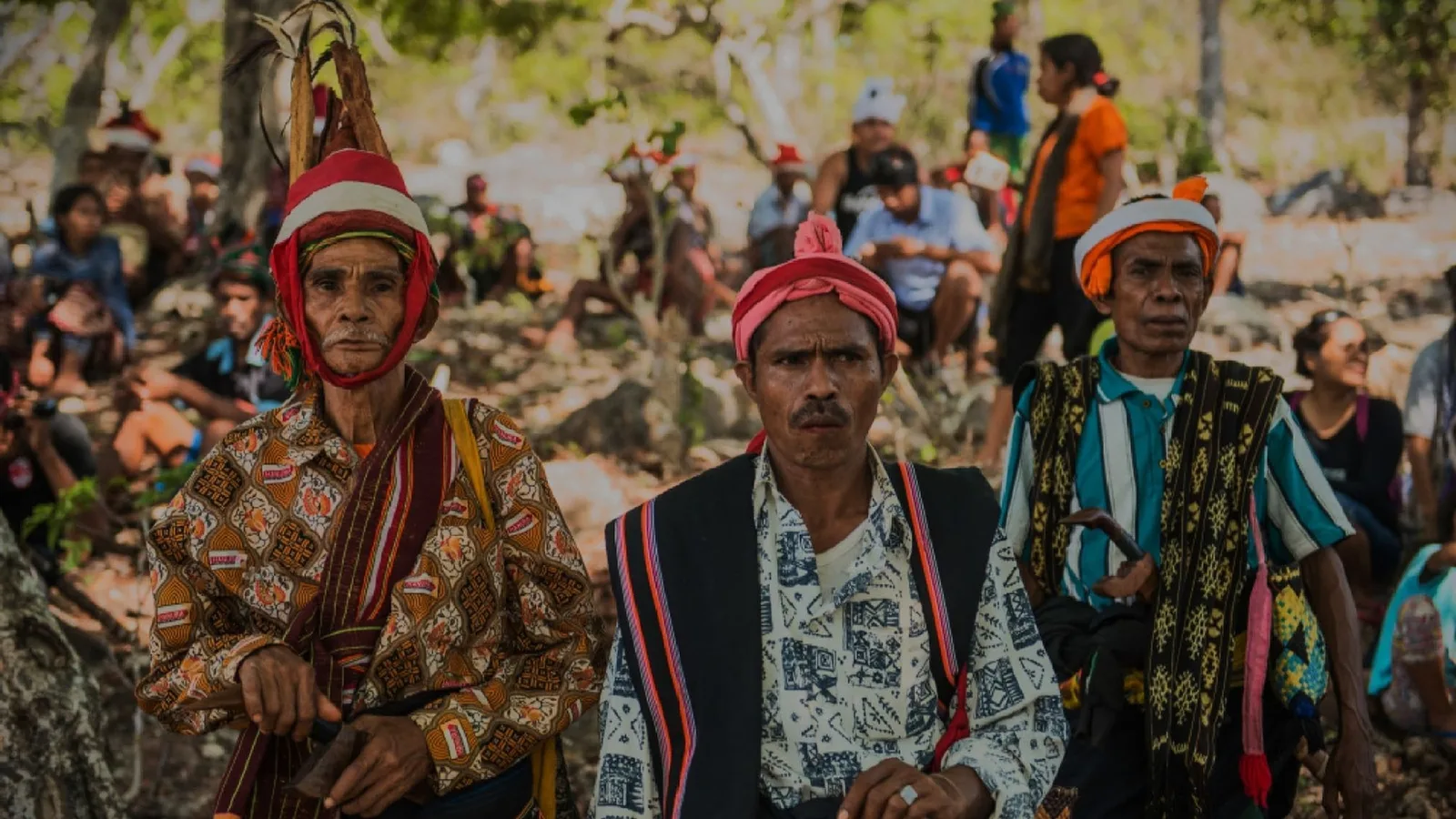
The man wasn't weeping; he was calculating. Crouched on a woven pandan mat in the shade of a soaring, grass-roofed house, Rato Umbu held a knotted length of dried palm frond. His thumb moved deliberately from one knot to the next. His lips moved, but no sound emerged beyond a dry whisper. Each knot was a debit, a specific water buffalo owed to a specific clan for a past contribution. This wasn't an act of mourning. It was a grim audit.
His brother had died three months prior, but his body remained, preserved with traditional methods, in the family home. The funeral could not proceed until the accounts were settled and the capital raised. Rato Umbu was a clan elder in a village outside Waingapu, on an island east of Bali that has more in common with the Bronze Age than the digital one. He was not tallying memories. He was staring down the barrel of a liability that could financially indenture his children and their children after them.
In my two decades covering markets, I’ve seen every sort of exotic financial instrument. I’ve analyzed collateralized debt obligations built on sand and sovereign bonds backed by wishful thinking. Yet nothing prepared me for this metaphysical balance sheet, where the primary currencies are animal life, social status, and ancestral obligation. Here, the dead hold more sway over capital allocation than any living central banker. And the single greatest transaction isn't an IPO or a real estate deal. It's a funeral.
The Funeral: A Clan's Ultimate Liability
To the Western observer, a grand Sumbanese funeral is a spectacle of bewildering, almost violent, pageantry. It is a multi-day ceremony of feasting, dancing, and the systematic, public slaughter of dozens, sometimes hundreds, of animals. But to view it through the lens of grief is to miss the point entirely. This is not a ceremony. It is the single largest capital expenditure a family will ever make, a moment of such profound financial consequence that it dictates the economic trajectory of a lineage for generations.
Consider the numbers. A high-ranking nobleman's funeral, which Rato Umbu was now obligated to orchestrate, can demand the sacrifice of over 100 water buffalo. The market for these animals is nuanced, but a respectable beast for such an occasion costs between 15 million and 35 million Indonesian Rupiah ($1,000 - $2,500 USD). A particularly magnificent animal, one with impressive horns and a calm demeanor deemed suitable for the ancestors, can command far more. The bill for buffalo alone can easily exceed $150,000. Add to that dozens of pigs, horses for the procession, and the cost of feeding hundreds, sometimes thousands, of guests for days on end. The total approaches a quarter of a million dollars.
This sum, in an economy where the average annual income struggles to reach $2,000, is functionally infinite. It is an impossible figure, which is precisely the point.
No single family possesses this kind of capital. Instead, the system functions as a complex web of reciprocal debt. The knotted cord Rato Umbu held was his living ledger. When his uncle died a decade ago, Clan B brought five buffalo. Their patriarch's funeral is next year; Rato Umbu must now return seven, the interest paid in social prestige and the reinforcement of alliances. When a cousin married into Clan C, they contributed two prize pigs to a feast; a magnificent horse is now owed for this upcoming funeral. It is a system of interlocking obligations that makes the pre-2008 derivatives market look like a child's game of marbles. The social pressure to uphold these debts is absolute. To scale down, to host a 'fiscally responsible' funeral, would be an admission of failure, a declaration of social bankruptcy more shameful than any financial default. It's a 'too big to fail' mentality applied to the clan, where honor, not currency, is the asset being protected at all costs.
I watched Rato Umbu finally put down the knotted cord. He looked up, not at me, but towards the horizon, as if trying to see the herds of animals that existed only as promises. "The cost is not the issue," he said, his voice raspy. "The cost is the measure. It is how the ancestors know we have not forgotten them. And how our rivals know we are still strong." It was the most succinct, and terrifying, explanation of a ritual economy I had ever heard.
Marapu's Fixed Assets: The Megalith as Collateral
If funerals are the system's largest liability, the great megalithic tombs are its most significant fixed assets. These colossal stone slabs, dragged for miles and erected with immense effort, litter the landscape of the island's west. They are not mere gravestones. In the logic of the Marapu belief system—an animist faith centered on the veneration of ancestors—these tombs function as a clan's permanent, public declaration of creditworthiness.
Think of them as a physical manifestation of a Moody's AAA rating. They are illiquid, immovable, and incredibly expensive to create. Their very existence signals that the lineage buried within was, and therefore still is, a clan of substance. They are collateral posted against the promise of a family’s enduring status. The cost of their construction is measured not in rupiah, but in the blood of sacrificed animals and the sheer logistical power required to move them. To drag a single, 15-ton stone slab from a quarry to a village can require a force of 500 men and women pulling on rattan ropes for days. This effort must be sponsored by the commissioning family, who are required to host a massive feast for the entire community and sacrifice at least 10 to 15 buffalo and pigs. The all-in 'cost,' if one were to monetize it, is easily equivalent to buying a new Toyota Hilux pickup truck in cash.
This process is a live, public audit. As the stone inches across the landscape, every observer is mentally tallying the sponsor's expenditure. They are assessing the quality of the pigs being slaughtered, the number of buffalo tethered nearby, the generosity of the rice and betel nut being distributed. Any sign of scrimping, any hesitation in the flow of resources, is noted and becomes part of the clan’s oral credit report. The successful completion of the task, culminating in the stone's placement, is a powerful statement. It tells allies and rivals: 'We have the resources to burn. We can afford to turn this much protein and labor into a non-productive asset. Do not doubt our strength.'
This system draws a fascinating parallel to the Potlatch ceremonies of the Pacific Northwest Indigenous peoples. Anthropologists like Franz Boas were once baffled by these gatherings, where chiefs would affirm their status by giving away or even conspicuously destroying vast quantities of wealth. To an outsider, it seemed economically irrational. But within their closed system, it was the ultimate display of power and social solvency. Destroying wealth proved one had wealth to spare. Sumba's tomb-dragging is a form of constructive Potlatch. Instead of burning blankets, they 'burn' livestock and labor, crystallizing that expenditure into a permanent stone monument, an eternal testament to a moment of peak liquidity.
The Bride Price Bubble: Pricing a Lineage
In this ritual economy, every major life event is a transaction. And few are as fraught with financial complexity as marriage. The Sumbanese practice of 'belis', or bride price, is often romanticized as a charming tradition. From an economic perspective, it’s a high-stakes asset transfer between clans, a mechanism for alliance-building, and, increasingly, a speculative bubble that threatens to price an entire generation of young men out of the market.
Deconstructing 'belis' reveals its core function: it is not a 'purchase' of a bride, but compensation to her family for the loss of her productive and reproductive capacity. It is also a public valuation of her lineage. The 'price' is a meticulously negotiated basket of assets. For a woman of noble standing, the belis can be staggering. It's not uncommon for it to exceed 30 buffalo, dozens of pigs, several horses, and a collection of 'mamuli'—ancient, omega-shaped gold heirlooms whose value is determined more by their ancestral provenance than their mere weight. The total 'market capitalization' of such a transaction can easily surpass $75,000 USD.
According to elders in the Kodi region, this represents a near 200% increase in the 'price' of a high-status bride in the last 25 years, an inflation rate that far outstrips any conventional economic metric on the island. What is driving this? A confluence of factors. A daughter's advanced education can now increase her belis. A clan's rising political influence can do the same. And just like any other market, it is susceptible to rumor and speculative frenzy. If one clan successfully negotiates a record-breaking belis, it sets a new benchmark that neighboring clans feel compelled to match or exceed, lest they appear diminished.
This has created a dangerous bubble. The inclusion of modern assets—cash, motorcycles, even promises to fund the construction of a concrete house—has detached the practice from its purely traditional roots. It has become a hybrid monster: part ancestral obligation, part modern commercial transaction.
I sat with a young man named Yulius in a simple 'warung' in Waikabubak. He works as a hotel receptionist in Bali, sending most of his 5 million rupiah ($320) monthly salary home. "My family has identified a good match for me," he told me, scrolling through photos on his phone. "Her family is asking for 15 buffalo, 20 pigs, and five mamuli. My entire salary for ten years would not be enough. So my uncles must take on debt. Our family becomes poorer so I can marry. It feels... backward."
His predicament is the central paradox of the belis bubble. The system is designed to create alliances and display wealth, but its spiraling cost is now a primary driver of household debt and a significant barrier to social mobility for young men. They are trapped, forced to choose between a life of bachelorhood, marrying 'down' and damaging their family's status, or indebting their entire clan for a generation to secure a suitable wife.
Comparative Bride Price (Belis) Valuation - Noble Class
| Asset Component | 1998 (Estimated) | 2023 (Estimated) | Notes |
|---|---|---|---|
| Water Buffalo | 10-15 animals | 25-30+ animals | Increased demand for ritual sacrifice has driven up prices per animal. |
| Pigs | 20-30 animals | 40-50+ animals | Scale of feasting has increased. |
| Gold Mamuli (heirloom) | 3-5 pieces | 5-10 pieces | Value is in provenance, not just weight. Supply is fixed, demand rises. |
| Horses | 1-2 fine steeds | 3-5 fine steeds | Still a key marker of high status. |
| Cash & Modern Goods | Minimal / None | Up to $10,000+ USD | A recent, distorting addition to the traditional basket of goods. |
| Total Estimated Value | ~$25,000 USD | ~$75,000+ USD | Represents a ~200% increase in nominal valuation over 25 years. |
Ikat: The Labor-Intensive Luxury Good
Sumba's famous Ikat textiles are the island's most recognizable cultural export. These intricate, naturally dyed fabrics, with their powerful motifs of skulls, horses, and crocodiles, command high prices in the art galleries of New York, Paris, and Tokyo. They are celebrated as masterpieces of intangible cultural heritage. Viewed through the cold lens of labor economics, however, they represent a staggering arbitrage opportunity, where almost none of the value accrues to the creator.
The production of a museum-quality 'hinggi'—a large blanket worn by men—is an undertaking of almost monastic devotion. From planting and harvesting the cotton, to spinning the thread, to the months-long process of tying individual strands to resist the dye, to the patient immersion in vats of indigo (blue) and morinda root (red), the process can take up to two years. A conservative estimate of the hours involved for a single, complex piece is 1,500 hours of highly skilled labor.
Now, let's follow the money. That textile might eventually sell in a Zurich gallery for $8,000. A collector feels they've acquired a piece of profound, authentic culture. The gallery owner, after accounting for shipping, marketing, and margin, has done well. A local middleman or 'runner' on the island, who bought the piece from the village, takes his cut. What is left for the woman who spent 24 months of her life creating it? If she is lucky, she might receive 24 million rupiah, about $1,500. A quick calculation reveals her effective hourly wage: one dollar an hour. This is significantly below Indonesia's average minimum wage, which hovers around $1.70/hour, and a fraction of what a low-skilled construction worker earns in booming Bali.
I spoke with a master weaver in a small eastern village, her fingers permanently stained a deep indigo blue. She was working on a piece depicting the tree of life. "Weaving connects me to my mother, and her mother before her," she explained, not looking up from her work. "The patterns are given to us by the Marapu. It is a sacred duty." I asked her about the money. She paused. "The money is for my children's school fees, for rice. It helps, yes. But it cannot pay for a single buffalo for my father's funeral. It is not that kind of money." Herein lies the disconnect. The weaver sees her work as a sacred act, and the cash she receives as a helpful but secondary supplement. The global art market sees it as a luxury good, a commodity. The vast gulf between these two perceptions is where the value is lost to the producer. She is creating a global luxury good for a local subsistence wage, a classic case of value chain distortion where the primary producer is almost entirely disconnected from the final market price.
The Pasola Portfolio: A High-Stakes Hedge
Twice a year, on the western shores of the island, a form of ritualized chaos erupts. The Pasola festival is a battle on horseback between two rival groups of men, who charge at each other hurling blunt-tipped wooden spears. It is a thrilling, terrifying spectacle, often marketed to tourists as a kind of medieval jousting tournament. But to frame it as a 'game' is to misunderstand its fundamental economic and spiritual purpose. The Pasola is not a sport; it is a high-stakes, faith-based hedge.
The core belief underpinning the festival is that bloodshed fertilizes the land. The more blood that spills onto the fields—whether from men or their horses—the more bountiful the coming rice harvest will be. This establishes a direct, explicit link between physical cost (injury and, historically, death) and expected economic return (a good harvest). It is a form of risk management rooted in metaphysics, not meteorology. By offering blood to the earth and the spirits, the community believes it is securing its agricultural future.
This presents a fascinating dilemma for modern authorities. Officially, deaths are forbidden. Unofficially, they happen. Local clinics consistently report a 30-40% spike in trauma injuries—broken bones, deep gashes, concussions—during the week of the Pasola. The return on this investment of human suffering is, by its very nature, unprovable. There is no way to run a controlled experiment to verify if a bloodier Pasola actually yields more grain. The ROI is entirely faith-based.
Watching the event is a lesson in controlled frenzy. The air is thick with the smell of sweat, horseflesh, and a kind of electric tension. I found myself focusing on the face of a single rider as he galloped full-tilt towards the opposing line. He was a young man, perhaps in his early twenties, his face a mask of concentrated terror and ecstatic abandon. As a spear flew towards his head, he ducked at the last possible second. In that split-second, he was making a bet. A bet against fate, a bet on his own skill, and a bet that his personal risk was contributing to his community's collective prosperity. The authorities and the nascent tourism industry tolerate this dangerous anachronism with a nervous unease. They know it is a vital social release valve and a powerful cultural symbol. They also know it is one errant spear away from a public relations catastrophe. But for the participants, the calculation is simple. It is a necessary, terrifying, and sacred transaction with the forces that govern their survival.
The Buffalo Bond Market
In the absence of a formal banking system that understands ancestral obligations, Sumba has developed its own. The island's primary unit of account, its most trusted store of value, and its most important financial instrument is not the Indonesian Rupiah. It is the water buffalo.
This 'buffalo economy' operates almost entirely outside the purview of Jakarta's financial regulators. It is an informal, trust-based system for capital formation and debt management that is as complex as any on Wall Street. The total 'market capitalization' of ritual buffalo on the island—that is, animals held not for meat or labor but for their eventual use in ceremonies—is credibly estimated to be over $50 million USD. These are not just animals; they are walking, breathing financial assets.
At the heart of this system is the practice of 'buffalo loans'. If a clan needs ten buffalo for a funeral but only owns three, it will 'borrow' the remaining seven from allied clans. This debt is rarely recorded on paper. It is held in the collective memory of the community. The 'interest' on this loan is paid in social fealty and, most importantly, in the obligation to return a greater number of buffalo at a future ceremony. A loan of one buffalo may require a return of two a decade later, an effective annual interest rate of about 7%, albeit paid in livestock, not cash.
What makes this market truly unique is the 'ritual premium'. A trip to any animal market on the island reveals this pricing anomaly. Two buffalo, identical in weight and health, will be offered at vastly different prices. The cheaper one is destined for a butchery in Java. The more expensive one, valued at a 20-30% premium, is deemed 'ritually suitable'. Its horns are perfectly curved, its coat is a uniform color, its temperament is placid. These aesthetic qualities have zero impact on its value as meat. But in an economy where the animal's primary purpose is to act as a messenger to the ancestral world, these features are paramount. They are specifications for a spiritual transaction.
I watched two elders at the market in Anakalang negotiate for over an hour over a single bull. Their hands traced the curve of its horns, they inspected the texture of its hide, they spoke in low tones about its lineage. Theirs was a language of value that had nothing to do with kilograms and everything to do with its suitability for communicating with the dead. The seller was not just selling an animal; he was selling a key component for a sacred ritual. The buyer was not just purchasing livestock; he was acquiring the means to settle a metaphysical debt. This premium is the price of entry into the most important market on the island.
The Authenticity Tax: Tourism's Distortion Field
The arrival of global capital on the island's shores has introduced a new, and deeply distorting, variable into this ancient economic equation. The southern coast is now home to some of the world's most exclusive and expensive resorts. Nihi Sumba, for example, once voted the best hotel on the planet, can charge thousands of dollars per night. This influx of wealthy, experience-seeking tourists has inadvertently created a 'performance economy'.
The tourist's desire for 'authentic' cultural encounters has become a new commodity. This creates what I call the 'authenticity tax'—a premium paid for access to rituals that are increasingly staged or modified for an outside audience. Local 'cultural brokers' or 'fixers' have emerged, individuals who straddle the worlds of the village and the resort. A foreign photographer wishing for 'exclusive' access to a real funeral might be quoted a fee of $500 to $1,000. This fee rarely gets distributed beyond the fixer and a few key village elders. It does not go towards settling the clan's vast buffalo debt. Instead, it creates a new, cash-based micro-economy that incentivizes the performance of culture rather than its organic practice.
This commodification can lead to bizarre and unsettling distortions. A local guide, speaking on condition of anonymity, recounted a recent incident. A minor harvest ritual, whose date is traditionally determined by the high priest's observation of the moon and the appearance of a particular sea worm, was quietly shifted by three days. Why? To coincide with the stay of a particularly wealthy hotel guest who had expressed a keen interest in witnessing it.
Is tourism providing a viable economic alternative to the crushing ritual debt system? The evidence is mixed. On one hand, it creates jobs and brings cash into a largely non-cash economy. On the other, it threatens to debase the very traditions it seeks to witness. The presence of an audience with cameras changes the nature of the event. A sacrifice made for the ancestors feels different when it is also a photo opportunity for a tourist paying for the privilege of watching. The risk is that the complex web of Marapu belief, the entire metaphysical balance sheet, becomes just another piece of exotic set dressing for a luxury holiday. The authenticity tax is paid by the tourist, but the long-term cost may be borne by the culture itself.
An Inheritance of Debt
The ultimate question is one of sustainability. For Sumba's educated youth, their cultural inheritance is a source of both immense pride and profound anxiety. Is it a noble legacy or a financial prison? This generation, connected to the outside world via smartphones and university educations in Java and Bali, lives with a foot in two irreconcilable eras.
They face a brutal juxtaposition. In Jakarta, they can aspire to a modern career, a mortgage, a life defined by individual achievement. But back home, the demands of the clan remain supreme. Their starting salary as a junior accountant might be dwarfed by the obligation to contribute just one buffalo to a single family funeral. The pressure to return and participate is immense. To refuse is to commit a form of 'ritual default', a decision that can lead to social ostracization. Families have been torn apart by children who 'opt out', who refuse to pour their modern earnings into the ancestral system.
The numbers bear this out. The youth out-migration rate from the island's more traditional rural districts, particularly in the west, is estimated at over 15% annually. Young people are voting with their feet, seeking jobs in the cash economies of more developed islands, not just out of ambition, but out of a desperate need to escape a system of debt they cannot possibly service.
Funeral Cost vs. Modern Asset Comparison
-
Cost of a Paramount Chief's Funeral: ~$250,000 USD
- Includes: ~200+ buffalo, hundreds of pigs, horses, multi-day feasts for thousands.
- Nature: Intangible social and spiritual capital, debt settlement.
-
Cost of a New 3-Bedroom Luxury Villa in Canggu, Bali: ~$250,000 USD
- Includes: Pool, modern kitchen, 25-year leasehold, en-suite bathrooms.
- Nature: Tangible, income-generating asset (rental yield ~8-12% p.a.).
I met a young woman named Anna in a Jakarta coffee shop. She is in her final year of a law degree. She scrolled through photos on her gleaming iPhone, showing me images from her grandfather's funeral two years earlier. There were hundreds of people, lines of tethered buffalo, a massive tombstone. It was a magnificent, powerful display. "I am proud of this," she said, her voice soft. "It shows who we are. But I cannot afford to live in it." She locked her phone and looked out at the city's relentless traffic. "It feels like inheriting a beautiful, expensive museum that I am now legally and spiritually obligated to maintain for the rest of my life."
Her words hung in the air. The intricate Marapu cosmology ensures the ancestors are honored with staggering displays of wealth. But for the living to satisfy the dead, they must remain in a state of perpetual, sacred debt. The question for Anna's generation is not whether they can afford to continue the rituals, but whether their own future is the final price to be paid.