The Loom as Oracle: Weaving the Afterlife in Sumba
In a courtyard of dust and sunlight, where the heat presses down with the weight of an old story, a woman sits before a constellation of threads. They stretch from a harness at her waist to a weathered wooden post, a fragile galaxy held in tension. This is Prailiu village, and the woman is Ibu Katarina. She is seventy, maybe older; time here is measured in harvests and ceremonies, not years. Her fingers, stained a deep, bruised blue from indigo, move with the startling quickness of a hunting spider, tying impossibly small knots of dried palm leaf onto the pale cotton warp. Each knot is a secret held against the coming dye. The rhythmic thwack of her weaving sword, a heavy sliver of polished wood, is not the sound of making. It is the sound of remembering.
The air hangs thick with the scent of woodsmoke and sleeping dogs. A few chickens peck at the ochre earth. Beyond the bamboo fence, the modern world announces itself in the whine of a distant motorbike, a sound as alien here as a jet plane. But inside this small radius of creative force, another logic prevails. Ibu Katarina is not merely weaving a blanket. She is plotting a course, transcribing a cosmology, preparing a vessel. Each motion is a prayer. Each emergent pattern, an echo of a soul’s long, and often perilous, journey home.
To be here, at the edge of the Savu Sea, is to feel the gravitational pull of a different kind of time. It’s a place where the spreadsheet logic that governs so much of our lives—the calculus of return on investment, of linear progress, of time as a commodity to be spent—simply dissolves in the humid air. Here, the most valuable assets are not measured in square meters or stock points, but in the depth of a color, the complexity of a pattern, and the weight of a story held fast in a thousand threads.
An Inheritance of Blue
Before a single thread is stretched on a loom, there is the color. All life in Sumbanese textiles begins with blue, a blue so profound it feels less like a pigment and more like a state of being. To witness its creation is to step into a world of alchemy and spirit. In a shaded corner of the village, great clay vats sit half-buried in the earth, fermenting a pungent mash of indigo leaves. The smell is not unpleasant, but it is potent and alive—a loamy, earthy breath that speaks of decay and transformation. This is the realm of wora, the local name for indigo, but the word carries connotations far beyond color. It evokes the celestial, the upper world, the feminine principle, the very firmament of the heavens.
An elderly master dyer, her arms stained to the elbow with the ghost of a thousand previous dyeings, approaches the vat with a reverence usually reserved for an altar. She makes a small offering of betel nut, whispering to the spirits that inhabit the dye. There are strict taboos. A heart full of anger can spoil the batch; a menstruating woman, whose own sacred cycle is considered too powerful, cannot come near lest the spirit of the blue flee. The dyer takes a bundle of hand-spun cotton yarn, still a pale ecru, and submerges it in the murky, greenish-yellow liquid. After a few minutes, she pulls it out. For a breathtaking moment, it remains a sickly chartreuse. Then, as the oxygen in the air greets the threads, the magic happens. A slow blush of cerulean appears, deepening by the second, transforming before your eyes into a rich, undeniable blue. It feels like watching a thought become a thing.
This process is the opposite of instant gratification. To achieve the most coveted shade, a near-black midnight blue that the Sumbanese call 'the color of a moonless night,' a master dyer will dip a single bundle of yarn into the indigo vat more than 20 times over a period of four weeks. Each submersion adds a layer of depth, a layer of story. The resulting color is not flat or uniform, but alive with subtle variations, a testament to the patience of its maker and the mood of the spirits in the pot.
'The blue is not a color we make,' Ibu Katarina told me later, her fingers still working the threads. 'It is a spirit we invite into the thread. If our hearts are not clean, or if we are impatient, it will not stay. It will be weak. But if we are calm and our intention is true, it becomes part of us.'
To Bind the Pattern
Once the blue is secured, the true genius of the Sumbanese weaver reveals itself. The technique is known as ikat, from the Malay-Indonesian word mengikat, which means to bind, to tie, to resist. It is a form of resist-dyeing, but one of staggering complexity. Unlike batik, where wax is applied to finished cloth, in ikat the resistance is tied directly onto the threads of the warp before they are woven. This means the weaver must conceive of the entire, intricate final pattern in reverse, as a series of negative spaces, on a bundle of loose yarn. It is an act of intellectual and imaginative heroism, akin to composing a symphony in your mind, note by perfect note, before a single instrument is played.
There are other forms—weft ikat, where the horizontal threads are tied, and the rare double ikat, where both warp and weft are bound—but the warp ikat of Sumba possesses a particular power. The patterns have a feathered, slightly hazy edge, a result of the immense difficulty of perfectly aligning thousands of individually dyed threads. This is not seen as an imperfection. Instead, it gives the motifs a shimmering, ethereal quality, as if they are emerging from another dimension, which, in a sense, they are. A single, complex hinggi, the large rectangular mantle worn by men, can require a specialist pattern-binder to tie over 10,000 individual knots from strips of dried palm leaf. This part of the process alone, the binding, can take up to three months of painstaking, eye-straining work.
I watched a young girl, perhaps fourteen, sitting beside her grandmother. Her brow was a knot of concentration as she tried to replicate a patola ratu, a noble motif derived from ancient Indian trade cloths. Her small fingers fumbled with the slick palm leaves. Her grandmother didn't speak. She simply reached over, her own ancient hands guiding the girl's, her touch a conduit for a knowledge that defies vocabulary. The pressure of her thumb, the angle of her wrist—this was the classroom. The girl sighed, undid her clumsy knot, and began again. She was not just learning a craft; she was being initiated into a way of seeing, of thinking in reverse, of holding a universe of form within a skein of undyed thread.
The Woven Lexicon
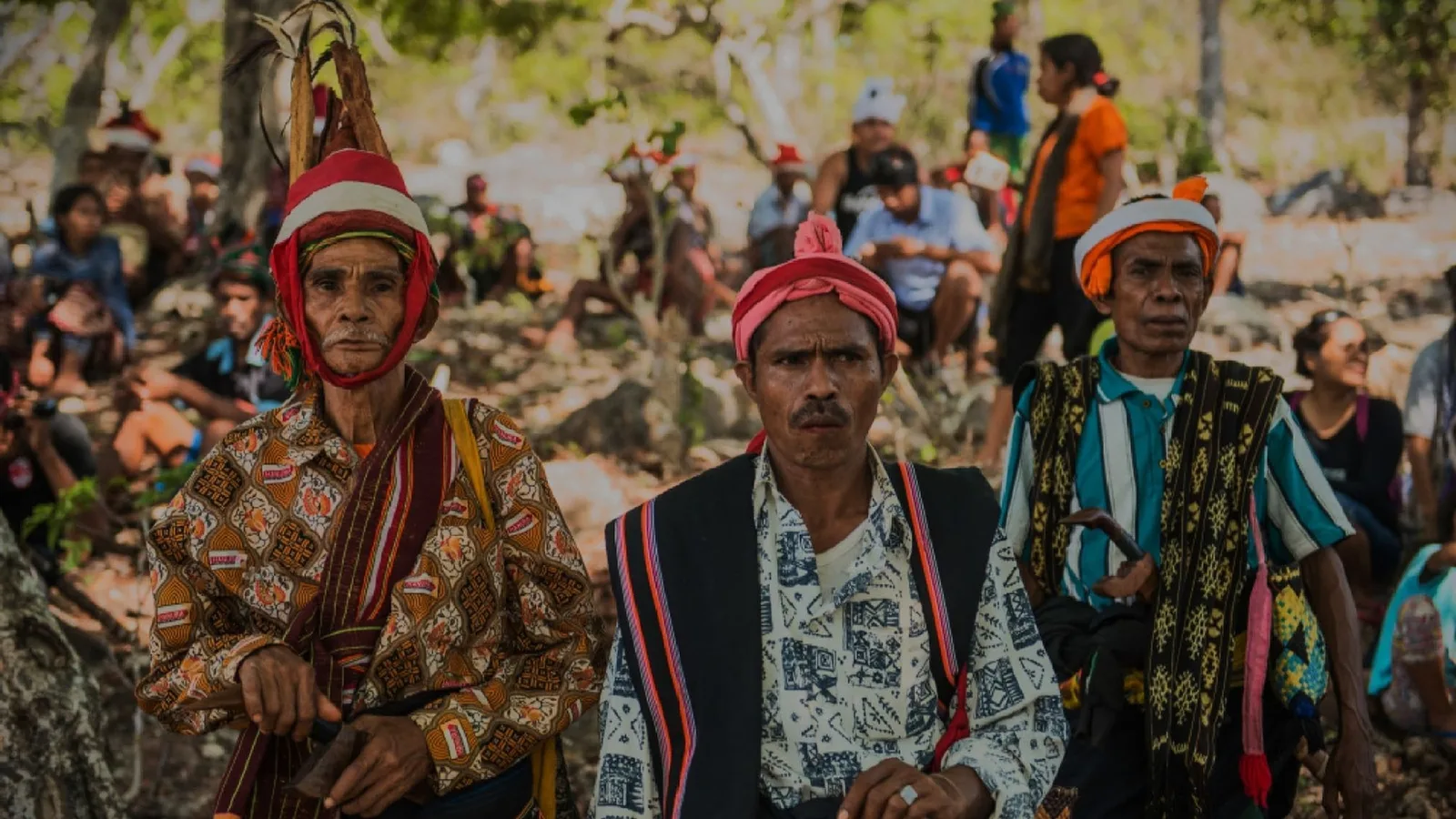
To the uninitiated eye, a Sumbanese textile is a beautiful, abstract arrangement of figures. To a local, it is a text, a map, and a biography. Each cloth is a woven lexicon, dense with meaning. A master weaver must memorize a vocabulary of over 100 distinct, named motifs, each with a specific definition and a strict protocol for its placement. The designs are a startling bestiary of the real and the imagined. Noble horses, symbols of wealth, status, and the vehicle that transports the soul to the afterlife, gallop in regal procession. Roosters, feathers rendered in exquisite detail, represent masculinity, courage, and the vigilance needed to ward off evil spirits. The most powerful and fearsome motifs are the skull trees, or palarang, stark branches hung with the heads of enemies, denoting immense warrior prowess and ancestral power. These are not merely decorative; they are active agents of spiritual force.
The layout of a hinggi is a deliberate cosmology. The cloth is typically divided into sections that correspond to the three worlds of Sumbanese belief: the upper world of the creator and spirits, the middle world of mortals, and the lower world of the sea and its reptilian creatures. Thus, you might see birds and celestial symbols at the top, horses and human figures in the middle, and crocodiles or sea serpents at the bottom. To wear such a cloth is to wrap oneself in the entire cosmos, placing oneself at the center of the vertical axis between heaven and earth. Unlike the Bayeux Tapestry, which chronicles a single, linear historical event for public display, a Sumbanese hinggi serves as a personal, cyclical cosmology. It is a Bayeux Tapestry for the soul, mapping not a nation's past, but an individual's passage through the eternal cycles of life, death, and ancestry.
Over centuries, this lexicon has absorbed foreign words and adapted them. Dutch heraldic lions, introduced by colonial officers, rear up next to indigenous cockatoos, their European forms softened and 'Sumbanized' by the ikat's feathered edges. Dragons and phoenixes, echoes of Chinese trade porcelain, chase each other across fields of indigo. But they are no longer Dutch or Chinese; they have been captured by the loom, their foreign power harnessed and assimilated into the local spiritual grammar. An old man in the village of Rende, his own hinggi draped over his shoulder like a toga, pointed to a distant figure walking across a parched field. 'That man,' he said, squinting, 'is from the house of the black snake. His grandfather married a woman from the village of the four roosters. I can see it on his cloth.'
A Currency of Cloth
In the West, we have largely demystified our currency. Money is an abstract, dematerialized force, a series of digits on a screen. In Sumba, the ultimate form of wealth remains profoundly tangible, imbued with spirit and story. Here, textiles are the island’s social glue, a currency of cloth that binds families, settles disputes, and defines status in a way that mere cash—the Indonesian Rupiah—cannot. While money is necessary for daily transactions, it is cloth that moves at the moments that matter: birth, marriage, and death.
Nowhere is this more apparent than in the elaborate negotiations surrounding a marriage. The alliance is not sealed with a ring, but with a massive and complex exchange of goods between the two families, creating debts and bonds that will echo for generations. The bride's family, the 'wife-givers,' presents items considered female, such as pigs, ivory bracelets, and ornate metal pendants called mamuli. The groom's family, the 'wife-takers,' must counter with male items: water buffalo, horses, and, most importantly, textiles. A standard high-status marriage proposal requires the groom's family to present at least four prime horses and anywhere from 10 to 20 high-quality hinggi and women's skirts, known as lau. This initial exchange can be valued at over $15,000 USD, a staggering sum in an economy where the average annual income is a fraction of that. But to value it in dollars is to miss the point entirely. The cloths are not being 'spent'; they are being woven into the fabric of a new kinship.
At a weekly market in a dusty crossroads town, the real economy hums. I watched a man intently inspect a stout water buffalo, running his hand along its flank. The owner stood by, arms crossed. The negotiation was not in rupiah. The buyer offered two lau skirts and a simple hinggi. The owner scoffed, gesturing to the animal’s broad shoulders. The haggling continued, a complex algebra of cotton and flesh. Eventually, they settled on a price: one water buffalo for five high-quality lau pahikung (skirts with a complex supplementary-weft technique) and two fine hinggi kombu, their rich red dye speaking of high value. The deal was struck with a handshake. They were not just trading commodities; they were trading condensed labor, sacred patterns, and ancestral prestige. In a world of volatile markets, these textiles represent a store of value that is both stable and deeply meaningful. It's a balance sheet of the soul. In East Sumba, the large rectangular hinggi cloths are traditionally woven by men, while the tubular lau skirts are the exclusive domain of women, creating a beautiful, gendered balance in the production of this ritual wealth.
Threads of the Marapu
To understand the almost fanatical devotion to these textiles, one must look beyond aesthetics and economics to the spiritual heart of the island: the animist faith known as Marapu. Though many Sumbanese are nominally Christian, the old ways run deep, like a river beneath the soil. Marapu is a complex system of belief centered on the veneration of ancestral spirits, who act as intermediaries with the divine creator. It is these ancestors who dictate the proper order of the world, and it is through them that life's blessings flow. The weaver's loom is a primary altar for this faith. It is a portal.
Weavers are not considered mere artisans; they are mediums. The most complex and powerful designs are not invented but received. An ancestor, it is believed, will visit a weaver in a dream or a vision, bestowing a new pattern upon her. The weaver's sacred duty is then to manifest this spectral design in the material world. To fail in this task is to disrespect the ancestors and risk their displeasure. A Rato, a high priest of the Marapu faith, his teeth stained red from betel nut, explained it with unnerving clarity.
'When a woman dreams of a python, she knows her ancestor has sent her a new design. The snake is the pattern, and her fingers must follow its path on the threads. She must not change it. The cloth is not from her, it is through her.'
This belief imbues the textiles with an extraordinary spiritual gravity. They are, quite literally, clothing for the soul. The Sumbanese believe that after death, the soul undertakes a perilous journey to Prai Marapu, the ancestral village in the afterlife. The textiles in which the body is wrapped serve as its passport, its protection, and its identity card in that other world. Without the correct cloths, bearing the correct motifs of one’s lineage, the soul may become lost, unable to find its way home to the company of its ancestors. The very center-field of a sacred textile, the haingu, is considered the dwelling place of the spirit. It is often left undecorated or features a single, immensely powerful motif, a space woven not with pattern, but with pure intention. The most powerful ancient textiles, known as pusaka, are considered sentient beings. They are 'fed' with ritual offerings of betel nut and smeared with sacrificial animal blood during ceremonies to maintain their spiritual energy and keep them 'awake.'
The Guardian's Dilemma
This sacred tradition now finds itself at a precarious crossroads. The island is no longer a secret. The same qualities that preserved its unique culture—remoteness, a rugged landscape—are now attracting a new kind of attention. Tourists, collectors, and art dealers arrive seeking the authentic, and their money creates a powerful and dangerous vortex. The tension between preserving the sacred, slow, ritualized process and the temptation of quick cash is palpable in every weaving village.
This pressure has bifurcated the craft. On one hand, there is the authentic tradition; on the other, a faster, commercialized version for the tourist market. The differences are stark and represent two entirely different value systems.
| Feature | Authentic Ritual Textile | Commercial Tourist Textile |
|---|---|---|
| Time | 6 months to 2+ years | 2 to 4 weeks |
| Dyes | Natural (Indigo, Kombu root) | Chemical (synthetic powders) |
| Process | Includes rituals, offerings, taboos | Purely technical, no spiritual rites |
| Motifs | Complex, ancestral, meaningful | Simplified, often poorly executed |
| Price | $500 - $5,000+ USD | $50 - $200 USD |
An authentic, naturally-dyed hinggi that takes two years to complete can sell for over $2,500, but a weaver can produce a brightly colored, chemically-dyed, and simplified version in three weeks for $100. The economic incentive to cut corners is immense. The formulas for the most potent natural dyes, especially the rich red from the kombu root, are fiercely guarded secrets passed down matrilineally, often whispered from mother to daughter on her deathbed. Cheap chemical powders threaten to erase this generational knowledge in a single generation.
I met Kornelia, a weaver in her late twenties from a village near the coast. She’s a guardian of the old ways, but also a pragmatist. She runs an Instagram account (@KorneliaIkat) to sell her family’s authentic textiles directly to a global audience. She spends as much time photographing the laborious dyeing process and writing long captions explaining the meaning of the motifs as she does weaving. 'My challenge is to educate,' she said, scrolling through her phone to show me a comment from a potential buyer in Germany balking at a $1,200 price tag. 'They see a piece of cloth. I have to make them see the two years of my mother's life. I have to explain the dream from my ancestor.' Her work is a slow, patient form of commerce, a world away from the rapid-build ethos of new coastal developments, like the much-whispered-about Eco Beach City project, that promise a different, faster future for the island. Kornelia is fighting to prove that the island’s most valuable resource isn’t its land, but its soul.
A Shroud for a King
The ultimate purpose of all this labor, all this patience, all this ancestral memory, culminates in a single, spectacular event: the funeral. In Sumba, a funeral is not a somber, quiet affair. It is the most important, expensive, and dramatic ceremony of a person's existence, a theatrical affirmation of their status and the strength of their lineage. At the center of this grand drama are the textiles. When a high-ranking noble dies, their body is not immediately buried. It is seated in their home, as if still presiding over the household, and is ritually dressed and wrapped in dozens, sometimes hundreds, of the finest cloths collected over a lifetime and donated by mourning relatives. This is not the wrapping of a corpse; it is the equipping of a soul.
The sheer volume of wealth expended is astonishing. The 1982 funeral of the last Raja of Rende, an event still spoken of in hushed tones, famously involved the wrapping of his body in over 150 unique, hand-woven textiles, a magnificent hoard of ancestral and personal wealth accumulated over his 80-year life. The full complement of cloths required for a high-ranking funeral can be valued at upwards of $70,000 USD. For the same price as a new Tesla Model S in Europe, a family here secures not a symbol of future technology, but a vessel of ancestral memory, ensuring a soul's safe passage into eternity.
I was fortunate, if that is the word, to witness the procession for a lesser nobleman. The body, already wrapped into a magnificent, textile-clad effigy, was carried on a gorgeously decorated palanquin by dozens of men. It was a moving monument of woven art, a mountain of indigo and rust-red, shimmering with ancient symbols of skulls and rampant lions. Hundreds of people followed, the air thick with the sound of gongs and chanted laments. Buffalo were slaughtered, their blood soaking into the dry earth as a final offering. It was a spectacle of almost overwhelming sensory and emotional power—grief and wealth, art and death, all woven together. Each layer of cloth on that body was a story, a relationship, a debt repaid, a prayer from the living for the journey of the dead.
'We send him home in a ship of cloth,' a mourner told me, his face streaked with tears and dust. 'So the ancestors will see him coming from far away and know he is one of us.'
The Unbroken Thread
The loom sits in the quiet courtyard. The sun is lower now, casting long shadows. Ibu Katarina has added another few centimeters to the emerging pattern. It is slow work. It is soul work. Here, in the patient back-and-forth of the shuttle, in the tension of the warp, the Western conception of time as a line stretching from a fixed past to an unknown future feels like a flimsy and inadequate story. The Sumbanese loom offers a different model. It is a site where past, present, and future converge. The patterns are from the ancestral past, the weaver's hands are in the present, and the cloth's destiny is in the future—as a shroud, a dowry, a passport to the afterlife.
This worldview, where life is woven into being by ancestors and one in turn weaves the means of one's return, is extraordinarily resilient. Despite colonization, the arrival of world religions, and the encroaching pressures of the global market, the thread remains unbroken. A 2019 survey by Udayana University confirmed this, finding that over 90% of ritual events in East Sumba—marriages, funerals, house-building ceremonies—still require the ceremonial exchange of local textiles. The cloth endures.
Ibu Katarina finishes a row and looks up. Her eyes, clouded with age, are sharp and clear. I ask her who the beautiful, complex cloth is for. A daughter's wedding, perhaps? A gift for a grandchild? She smiles, a small, knowing smile. 'It is for me,' she says, her voice a soft rasp. 'For when I go.' She explains that she began this, her own funeral shroud, ten years ago, working on it between other projects, choosing the most powerful motifs, dyeing the threads in the richest indigo she could make. The task is not morbid. It is the final, joyful act of a life spent in creation. It is the weaving of her own soul's conclusion. She is building her own ship for that final voyage.
To see a Sumbanese textile, then, is to understand that a thread is never just a thread. It is a line of lineage. It is a prayer made tangible. It is a map of the cosmos held in the hands. And the final cloth, wrapped around the silent body, is not an ending, but a key, unlocking a door woven shut long ago, returning a soul to the starlight from which its first color, the deep and knowing blue, was born.