Longitude Zero: In Search of Sumba's Unspoken Shores
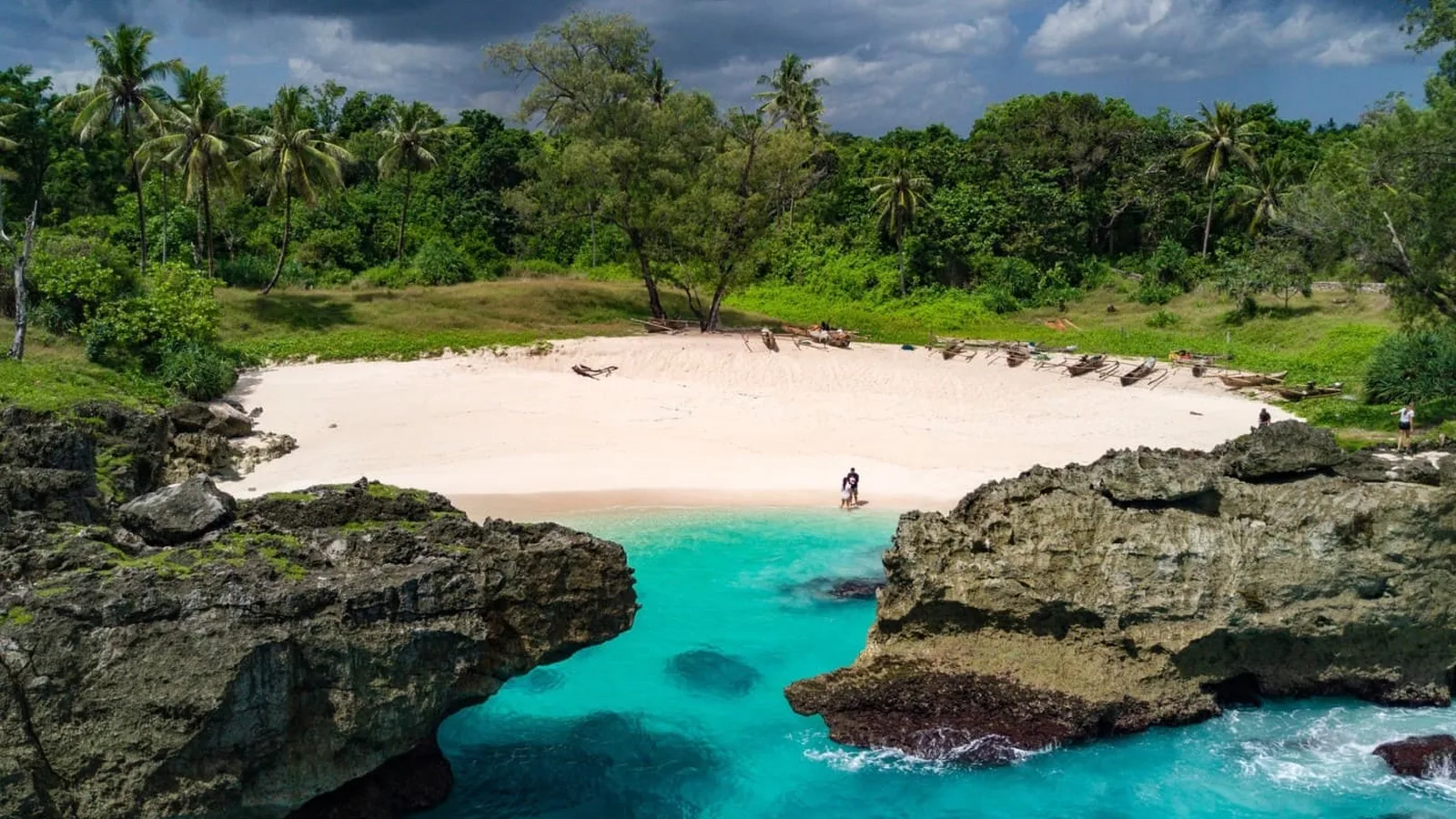
Yulianus pointed his chin, a gesture as precise as any GPS coordinate, toward a sliver of white sand barely visible between two monolithic, salt-scarred cliffs. He killed the sputtering engine of his Honda Supra, a machine held together by little more than rust and optimism. In the sudden, profound quiet that descended, a quiet so thick you could feel it press against your eardrums, the only sound was the rhythmic, percussive crash of waves some hundred feet below. It was a sound that didn't break the silence but defined it.
He pulled a half-smoked Djarum kretek from behind his ear, lit it with a practiced flick of a cheap lighter, and took a long drag. The sweet, cloying scent of clove mixed with the briny air. He looked at me, his eyes crinkled against the glare, a smile playing on his lips as if he knew something I was only just beginning to understand.
‘No name here,’ he said, his voice low, almost a whisper, as if speaking any louder would violate the sanctity of the place. He exhaled a plume of smoke that was instantly snatched away by the sea breeze. ‘Just sand, and ghosts.’ The sand I could see. The ghosts, I was starting to feel.
The Paradise Paradox
This island is a study in brutal contradiction. Eight years of living in Southeast Asia has taught me that the word ‘paradise’ is often a marketing term for a place that has successfully sanded down its rough, interesting edges for tourist consumption. But here, the edges are still razor-sharp. This is an island that is, on one hand, home to Nihi Sumba, a resort so exclusive and so lauded by glossy magazines—regularly voted the ‘best hotel in the world’—that a one-bedroom villa can command upwards of $1,945 a night in peak season. It’s a place of thread-count-obsessed luxury, private butlers, and world-class surf breaks served up on a platter of manicured perfection.
And then there’s everything else. The other 99.9% of the island. A place of staggering poverty, animist traditions that feel more ancient than the stones they worship, and a raw, untamed beauty that feels both thrilling and vaguely threatening. My mission, if you could call it that, was to navigate the immense, unmapped space between those two poles. To find the authentic geography that exists in the shadow of this burgeoning, billion-dollar luxury market, before the cartographers of capital arrived to chart it, subdivide it, and sell it off, one beachfront plot at a time. This wasn't about finding 'hidden gems'; it was about understanding what 'undiscovered' truly means in a hyper-connected world, and what value, if any, remains in a place that has yet to be fully geotagged and Instagrammed into submission.
Navigating this landscape required abandoning every Western notion of efficiency. The roads, where they existed, were often little more than suggestions. Schedules dissolved into the Sumbanese concept of jam karet, or ‘rubber time,’ where ‘ten minutes’ could mean an hour and ‘tomorrow’ could mean next week. My journey was entirely dependent on the quiet knowledge of men like Yulianus, whose internal maps were not drawn with roads and landmarks, but with stories, spirits, and the subtle shifts in the wind. He was my guide, my translator, and my sole entry point into this unwritten world. His fee was a pack of cigarettes a day and enough rupiah for gasoline and two meals. In return, he was showing me an island that doesn't appear in any brochure.
West Sumba: In the Land of Left-Hand Breaks
The western part of the island is a wild, elemental frontier. This is where the Indian Ocean, after an uninterrupted journey of thousands of kilometers, finally unloads its power onto shores of staggering, dramatic beauty. The beaches you find on maps—Marosi, Kerewei, a handful of others—are stunning, but they’re just the opening act. Drive another ten minutes down a goat track, hike over a grassy headland, and you can find yourself utterly, completely alone on a mile-long stretch of sand that feels like it was minted at the dawn of time.
These aren't the gentle, lapping shores of a Thai postcard. The water here has a voice, a deep, guttural roar that speaks of its power. We stood on the cliffs above one such unnamed bay, the wind so strong it was hard to stand upright, watching as twelve-foot sets rolled in and detonated against the reef. It felt less like a beach and more like a geological event. ‘Not for swimming,’ Yulianus said, stating the obvious with a grin. ‘Only for looking.’
Later that day, tucked into a more sheltered cove, we saw it. The island officially boasts over 17 documented surf breaks, but local riders whisper of at least 30 more, many accessible only by boat or a punishing overland trek. Out on the water, a lone figure on a surfboard sat patiently, a tiny speck against the vast blue. For ten minutes he waited. Then, a line appeared on the horizon. As it approached, the wave began to stand up, peeling perfectly from right to left in a long, flawless wall of turquoise. The surfer, a local kid with sun-bleached hair, paddled hard, dropped in, and carved a line of impossible grace across its face. For nearly a minute, he was part of the wave, a dance of man and ocean, a display of mastery in a place that felt utterly untamed. There were no other surfers. No photographers. No cheering crowd on the beach. There was just the rider, the wave, and us, two silent witnesses on the sand. It was a perfect moment, rendered more so by its utter lack of an audience. It was a secret kept by the sea.
'The wave doesn't care if you have a sponsor,' a weathered Australian surfer, who'd been coming here for twenty years, told me later over a warm Bintang beer. 'It doesn't care about your Instagram. It just is. That’s what we came for. That’s what’s disappearing.'
The Keepers of the Coast
The economic reality of this island is written in the tides. A few kilometers down the coast from where billionaires might be enjoying cocktails, I found Ibu Sarita waist-deep in the gin-clear water of a tidal flat, her face shaded by a wide-brimmed straw hat. For thirty years, she has worked this same patch of ocean, cultivating seaweed. Her hands, gnarled and calloused but deft, moved with a practiced rhythm, tying small fragments of seaweed to a web of nylon lines strung between wooden stakes.
She agreed to talk to me, her initial shyness giving way to a warm, gap-toothed smile when Yulianus explained I wasn't trying to buy her land. Her world is circumscribed by the moon and the tides. At low tide, she plants and she harvests. At high tide, she dries the harvest on vast tarpaulins spread across the beach, turning the brittle, salty fronds until they are ready to be bundled and sold to a middleman from the port town of Waikelo.
Her perspective on the coastline is granular, intimate, and stripped of romance. She sees the subtle changes in the currents, the health of the coral, the slow encroachment of plastic trash washed in from the ocean. ‘The sea has always given us what we need,’ she told me, her eyes scanning the horizon. ‘Fish when we are hungry, seaweed when we need money for school.’ I asked her about the new roads being paved nearby, the rumors of new hotels. She paused, her hands never ceasing their work. ‘I pray the new roads bring us things we need, not just things we want.’
Her labor is the first link in a global supply chain I’d never considered. The carrageenan extracted from her seaweed ends up as a stabilizing agent in everything from ice cream and toothpaste to cosmetics and industrial lubricants. Her average monthly income, she explained, is around 2.5 million Rupiah, about $155. It’s a figure that has, remarkably, risen by almost 40% in the last decade, driven by that same global demand. She is a primary producer in the truest sense, her livelihood a direct barometer of the health of this fragile marine ecosystem. Watching her work, a single, determined figure against the vastness of the ocean, I felt the profound disconnect between the abstract language of economic development and the tangible reality of a life lived by the sea.
The Limestone Labyrinth
Some of the island’s secrets are not kept by silence, but by geology. The central coast is a fortress of sharp, honeycombed karst limestone, a landscape designed to repel casual visitors. Yulianus had promised to show me a place he called ‘the hidden pool,’ and the journey to get there was a lesson in earning your destination. We left the bike where the dirt track dissolved into a sun-baked maze of rock and thorny brush. The 4.2-kilometer path to the coastline from the main road is completely impassable by any four-wheeled vehicle during the five months of the rainy season. Even in the dry season, on foot, it was a trial.
For an hour, we scrambled over and through the limestone labyrinth. The air was still and punishingly hot, thick with the sharp, dusty smell of dry earth and baked rock. Thorny branches scraped at my backpack and tore at my clothes. Sweat poured into my eyes. Every step was a negotiation with the terrain, a test of balance on the jagged, uneven ground. I was, I'll admit, beginning to question the wisdom of the entire enterprise, my city-softened body protesting with every step. Yulianus, clad in flip-flops, moved through it all with the effortless grace of a mountain goat, occasionally pausing to wait for me, a patient smile on his face.
And then, just as my resolve was beginning to crumble, the trail opened up. The scraping sound of branches gave way to the whisper of the wind, and the path simply ended at the edge of a cliff. Below us, revealed with the sudden drama of a curtain rising, was a scene of impossible perfection. A perfect crescent of fine white sand, enclosed on three sides by the limestone cliffs we had just traversed, met a body of water so intensely turquoise it seemed to hum with color. It was a natural swimming pool, protected from the ocean’s fury by a barrier reef. There were no footprints but our own. No scrap of litter. No sound but the waves and the wind. We had earned it. The exhaustion, the scratches, the sweat—it was the price of admission. It was a reminder that some of the most beautiful places on earth require a sacrifice, not of money, but of effort.
Salt-Stained Altars
To understand this coastline is to understand that you are walking on sacred ground. Long before the first surf charter or property scout arrived, the shores of this island were, and still are, a central pillar of the animist Marapu faith. This is not a quaint historical footnote; it’s a living, breathing part of daily existence for an estimated 35% of the island's population. For the Marapu, the world is a balance between the visible and the invisible, and the coastline is a critical threshold between the world of the living and the realm of the spirits.
Specific coastal features—towering rock formations, deep sea caves, the mouths of estuaries—are not just geological landmarks; they are sacred sites. They are the pintu masuk, the entry points for ancestral spirits returning to the island, or the physical manifestations of powerful deities. The famous megalithic culture, where villagers still haul multi-ton stones to construct elaborate tombs, is rooted in this same reverence for permanence and spiritual power. It’s no different with the natural cathedrals of rock that line the shore.
This creates a fascinating, and potentially explosive, tension. One afternoon near Watu Maladong, a beach famous for its colossal, arch-like rock formations, I watched from a distance as a small family picked their way across the tidal flats. They weren’t tourists. They carried small, woven leaf parcels. Reaching the base of one of the giant sea stacks, the patriarch, an old man with a deeply lined face, carefully placed the offerings—betel nut, rice, a few chicken feathers—into a crevice in the rock. He murmured a few words, his head bowed. It wasn't a performance. It was a quiet, intimate act of faith, a conversation with an ancestor or a god, as routine and necessary as mending a fishing net. The developer sees a dramatic backdrop for a five-star resort; the believer sees an altar. The Marapu faith dictates that many of these sites are strictly off-limits for building. The question hanging in the air is which belief system will prove more powerful in the coming decade. Can you put a price on a god's front door?
East of Eden: Savannah, Mangroves, and Seas of Glass
Driving east is like changing continents. The rugged, muscular topography of the west and south gradually softens, giving way to a landscape that feels more African than Indonesian. The annual rainfall here, in East Sumba, is nearly 50% less than in the west, averaging just 850mm. The result is a starkly different ecosystem. The lush green jungles are replaced by vast, rolling savannahs of golden grass, dotted with the distinctive, fan-like silhouettes of lontar palms. The coastline straightens out, the towering cliffs receding in favor of long, expansive beaches and calm, shallow seas.
Most visitors who make it this far are drawn by a single, iconic image: the ‘dancing mangroves’ of Walakiri beach. At sunset, the low tide reveals the strange, artfully contorted shapes of the mangrove trees, creating a photographer's dream. But as with everything on this island, the real magic lies just beyond the famous frame. We arrived at dawn, hours before any other tourists, and walked a kilometer down the coast from the famous spot. The world was rendered in pastel shades of pink and orange. The sea was a sheet of glass, mirroring the sky perfectly.
Then we saw them. A herd of the island’s famous wild horses, descendants of ponies traded by Chinese merchants centuries ago, emerged from the savannah. They came down to the shore, their hooves splashing in the shallows, their dark shapes silhouetted against the rising sun. For twenty minutes they galloped and played along the water's edge, a display of pure, unbridled freedom in a landscape that felt equally boundless. There was not another human being in sight for miles. The quality of light and space in the East is different. It’s less dramatic than the West, more serene. It doesn’t demand your attention with crashing waves and jagged cliffs; it invites it with an endless horizon and a profound sense of peace. It’s a landscape that empties your mind, a quiet expanse that feels like the end of the world, or perhaps the beginning.
The Price of Silence
With every perfect, empty beach Yulianus showed me, a cold, cynical part of my brain—the part that has seen this story play out from Phuket to Bali—was running the numbers. The silence I was savoring is now one of the world's most valuable and rapidly appreciating commodities. It's the raw material that the global tourism and real estate machine seeks to process, package, and sell.
In the small warungs and coffee shops, the whispers are getting louder. You see them now, the ‘scouts.’ Often young, sun-bleached Europeans or Australians, fluent in Bahasa Indonesia, poring over land certificates with village heads. They are the vanguard for foreign investors and Jakarta-based syndicates, mapping out the next wave of land acquisition. The data is stark. In the last five years alone, prime coastal land prices in the south have surged by over 800%. A plot that might have been had for $10 per square meter can now command over $80, and that's for land with a clear title and some semblance of road access. Speculation is rampant.
The most brutal arithmetic of 'progress' is the opportunity cost. A foreign investor might pay $350,000 USD for a 1-hectare plot of beachfront land to build a private villa. For that same amount, a local cooperative could purchase over 20 new fiberglass fishing boats with engines and nets, creating a sustainable livelihood for more than 40 families.
One evening, I sat with a village elder—a man carrying the weight of his community on his stooped shoulders. He was wrestling with a multi-billion Rupiah offer (a few hundred thousand US dollars, a fortune in local terms) from a developer for a stretch of community-owned beach. He spoke of his dilemma in hushed, pained tones. ‘The money could build a new school, a clinic,’ he said, staring into his cup of sweet, black coffee. ‘It could send our children to university.’ He paused, and turned his gaze towards the sea. ‘But the beach… the beach is where our grandfathers are buried. It is where we ask the spirits for a good harvest. If we sell the land, we sell our story. We sell our soul. What will our grandchildren have then? A good school, but no memory of who they are?’ It was a question with no easy answer, the central, heartbreaking equation of modern development.
| Item | Estimated Cost (USD) | Potential Local Impact |
|---|---|---|
| 1 Hectare Prime Beachfront Land | $350,000 - $800,000 | Single foreign-owned villa or small resort |
| 1 Fiberglass Fishing Boat (with engine) | $17,000 | Livelihood for 2-3 families, increased local food security, supports ~10 dependents |
| Community Investment Equivalent | ~$350,000 | ~20 fishing boats, supporting 40-60 families, or ~200 people directly |
The Unpenned Map
On my last afternoon, Yulianus took me to one final spot. It was, if possible, even more perfect than the others. A small, jewel-like cove, hidden behind a curtain of coconut palms. We sat on a piece of driftwood, sharing the last of his clove cigarettes, watching the sun dip towards the horizon. I had my phone in my hand, the map application open. It would have been so easy to drop a pin, to name it—‘expat’s cove,’ or something equally trite—to claim it in the small, digital way we now claim things. A single geotagged post from an influencer with 100,000 followers can, according to some studies, increase foot traffic to a ‘hidden’ location by an astonishing 1,500% in a single season. The act of documenting a place begins the process of its irretrievable transformation.
I thought of the 16th-century cartographers, painting sea monsters and writing ‘Here be dragons’ in the blank spaces of their maps. My journey felt like a modern, far less heroic parallel. Not charting new continents, but charting the last pockets of earthly silence—a terra incognita of the soul in a world that insists everything be known, rated, and reviewed. The realization was both simple and profound: my quest to ‘map’ the unspoken shores was a fool’s errand. The very act of mapping it for others, of giving names to the nameless, would be to destroy the very quality I had come to find.
I looked at Yulianus. He was watching me, that same knowing smile on his face. He knew what I was thinking. I closed the map application and put the phone back in my pocket. The pin remained undropped. The cove remained, for now, officially nameless. It would live on not as a coordinate on a screen, but as a feeling, a memory. A place that belongs only to the sand, and to the ghosts.