The Sun's Final Ledger: An Indonesian Atlas of Light
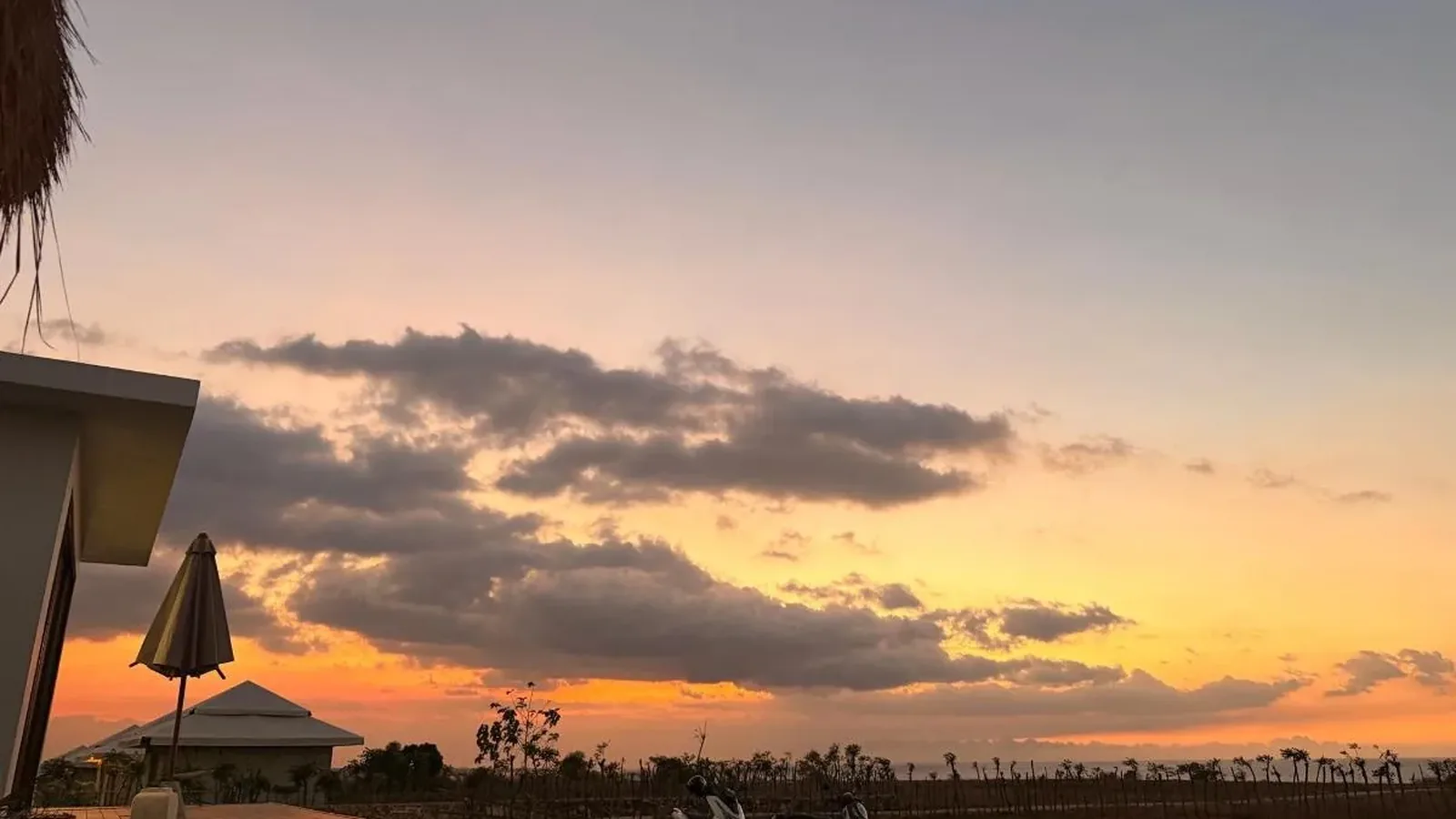
The gamelan’s frantic rhythm softens to a hum. On the cliff’s edge, the crowd is a held breath, an assembly not of people but of pure anticipation. A Barong dancer, masked and immense in his costume of fur and gilded leather, freezes mid-stride. His opponent, the witch Rangda, recoils. In that suspended moment, the heat from the performance torches on your face becomes indistinguishable from the day’s last, radiating warmth as the sun, a perfect vermillion disk, finally kisses the Indian Ocean. A collective sigh, part relief, part reverence, ripples through the amphitheater. The day is done.
But here, on this southern limestone promontory, the day’s end is never just an ending. It’s a performance, a transaction. It’s the moment the Javanese philosophical concept of Alus—the refined, the subtle, the unseen energy—visibly triumphs over the Kasar, the coarse and material reality of the day. For a few shimmering minutes, the fabric of the perceptible world tears, and you can glimpse the machinery behind it. This archipelago, a nation of 17,000 islands sprawling across three time zones, doesn't just experience sunset; it performs a two-hour-long liturgy with it, a rolling wave of devotion and accounting that moves from west to east.
To watch a sunset in Indonesia is not merely to witness a celestial event. It is to hold a diagnostic tool. Each island’s final light is unique, a specific spectral signature that illuminates the geology underfoot, the mythology overhead, and the human rituals in between. It is an atlas written in embers, and learning to read it is to understand the country's deepest truths.
The Overture: Uluwatu's Fire and Water
The performance is the point. Anyone who tells you to visit Pura Luhur Uluwatu simply for the sunset has missed the script entirely. The view is not the main event; it is the divine backdrop, the celestial lighting director for a drama that has been playing out for centuries. The limestone cliff, a sheer 70-meter (230-foot) drop to the churning surf below, is a natural stage that human ingenuity has transformed into a temple of commerce and spirit. The air is thick with the sweet, acrid smoke of clove cigarettes, the holy perfume of incense offerings, and the nervous chattering of long-tailed macaques who treat the entire affair as a dinner theater, snatching sunglasses and water bottles with the practiced ease of seasoned thieves.
At the center of it all is the Kecak dance. Dozens of bare-chested men become a living orchestra, their interlocking chants of “chak-a-chak-a-chak” forming a percussive wall of sound that seems to hold the sun in place. They are the monkey army of the Ramayana, and as the sky bleeds from orange to magenta, their battle against evil reaches its climax. The sunset is not incidental; it is a cue. The falling light signals the abduction of Sita, the rising flames of Hanuman’s trial by fire. You are not watching a dance in front of a sunset. You are inside a story being powered by the sun’s dying energy.
Backstage, in the humid crush of dancers applying makeup and adjusting headdresses, the air is electric. I found a young penari, a dancer, catching his breath, his chest still heaving. I asked him if he ever gets tired of the view, of this daily ritual. He smiled, a flash of white in the gathering gloom.
“The sun is the first god to arrive at the performance, and the last to leave,” he said, his voice a low whisper against the fading chant. “We just dance in between. It is not our show to get tired of.”
His perspective re-frames the entire economy of the place. A single night in a premium, west-facing cliff-front villa nearby, booked months in advance to guarantee a private version of this view, can cost upwards of $1,200 USD. That same amount could purchase roughly 6,000 kilograms of unmilled rice from a farmer in rural Flores—an entire year's harvest. One is an investment in a fleeting moment of beauty, the other an investment against the certainty of the coming night. Here, the final light of day illuminates the stark ledgers of value.
The Alchemist's Haze: Mount Bromo's Sea of Sand
Leave the coast. Travel inland and upward, into the highlands of East Java, where the air grows thin and the horizon is a jagged line of volcanic peaks. Here, the sunset is not a dialogue with water but with earth, smoke, and fire. To watch the day end from the lip of the Tengger caldera, looking out over Mount Bromo, is to witness an act of geological alchemy. The air itself becomes the artist’s medium. Fine volcanic dust from Bromo’s frequent grumblings, some of it suspended in the troposphere since an eruption in 2015, acts as a planetary color filter. It scatters blue light with ruthless efficiency, allowing only the most ardent reds, pinks, and oranges to complete the journey to your eye. The perceived saturation is intensified by as much as 30%, a beautiful, lingering scar left by geological violence.
This is not a gentle, painterly sunset. It is stark and monumental. The sun does not sink into a soft ocean but drops behind the cone of Mount Semeru, the highest peak on Java, casting the vast Laut Pasir—the Sea of Sand—into an ocean of shadow. The scale is disorienting, humbling. You feel like a spectator on a newly formed planet. The temperature plummets the instant the sun is gone, a reminder that all warmth here is a temporary gift from the sky, not a retained blessing from the earth.
My guide, a Jeep driver named Suyanto with a face as weathered as the caldera rim, poured a stream of hot, sweet Javanese coffee from a battered thermos into a tiny plastic cup. He didn’t look at the sky. He looked down, at the sprawling expanse of sand below us. “Look,” he said, pointing with his chin. In the low, acutely angled light, the caldera floor, which had seemed a uniform grey just minutes before, was now cross-hatched with faint lines. They were ghost trails, old paths made by pilgrims and pony-men, erased by wind and rain but held in the land's memory, visible only in these fleeting moments. “The mountain remembers everything,” Suyanto murmured, more to the cooling air than to me. For the Tenggerese people who live on this volcano’s flank, the sunset is not a spectacle. It is a daily communion, a quiet check-in with a power that gives them fertile soil and can, in a moment, take everything away.
| Sunset Characteristic | Uluwatu, Bali | Bromo, Java | Raja Ampat, Papua |
|---|---|---|---|
| Primary Sense | Sound (Gamelan) | Sight (Color) | Feeling (Silence) |
| Soundscape | Percussive, Chanting | Wind, Distant Motors | Lapping Water, Bird Calls |
| Human Element | Choreographed Ritual | Solitary Observation | Ancient Stillness |
| Dominant Feeling | Theatrical, Urgent | Austere, Monumental | Serene, Timeless |
The Prismatic Depths: Raja Ampat's Karst Silhouette
Fly east, far east, to the edge of the Pacific. Here, in the archipelago of Raja Ampat, the very concept of a singular sunset dissolves. It is not one event happening in the sky, but a thousand simultaneous events happening on, and under, the water. The horizon is a serrated edge of limestone karst islands, ancient coral reefs thrust from the sea, their shapes so strange and phantasmagorical they feel like a dream’s residue. The sun doesn't just set behind them; it plays between them, its light ricocheting off their salt-stained flanks, creating a labyrinth of gold and shadow.
But the real performance is happening below. This is a nexus of currents from the Indian and Pacific Oceans, a confluence that creates some of the most biodiverse and startlingly clear water on earth, with visibility that can exceed 30 meters. This clarity creates a second, submerged stage for the day's end. As the angle of the sun becomes more acute, the light penetrates the water differently. The surface becomes a sheet of hammered gold, but beneath it, the coral gardens ignite. Blues and greens deepen, while the oranges and reds of soft corals and sea fans, muted by the water's prism during the high sun of midday, suddenly flare to life. It is an underwater sunset, a final, feverish blush before the monochrome of night.
I was in a small dive boat, engine off, drifting through a channel in the Wayag islands. The silence was profound, a physical presence broken only by the occasional cry of a sea eagle and the gentle plop-plop of water against the hull. A few hundred meters away, a local fisherman sat in a tiny dugout canoe, a sliver of dark wood against the molten gold of the water. He wasn't fishing, his lines were drawn. His paddle rested across his lap. He was simply watching, his silhouette perfectly framed between two towering karsts, an image of such elemental stillness it felt as if it had existed for centuries. In the pellucid air of eastern Indonesia, the conditions are often perfect for the 'Green Flash,' a rare optical phenomenon where a final sliver of the sun appears to flash bright green at the very moment it disappears. Here, in the profound quiet, it feels less like a trick of the light and more like the planet's final, verdant exhalation.
The Soul's Palette: The Shifting Lakes of Kelimutu
On the island of Flores, the sunset ritual requires you to turn your back on the sun. Here, at the summit of the volcano Kelimutu, the day’s final light is not the subject but the illuminator. Its purpose is to reveal the true colors of the mountain’s tri-colored crater lakes, one of the world’s most sublime and unsettling geological wonders. As the sun descends, its golden light floods the craters, and what it shows is a palette dictated by geochemistry and myth.
For the local Lio people, these lakes are not just bodies of water; they are the resting places for departed souls. The colors are a form of spiritual communication. The westernmost lake, Tiwu Ata Mbupu (Lake of Old People), is typically a serene, placid blue. The other two, Tiwu Nuwa Muri Koo Fai (Lake of Young Men and Maidens) and Tiwu Ata Polo (Bewitched or Enchanted Lake), are wildly unpredictable, shifting between shades of turquoise, emerald green, milky white, and a terrifying, blood-like red. The colors are a result of chemical reactions between volcanic gases and minerals, creating pH levels in the red lake as acidic as 0.5. But science is just one language here. The other is spoken in the hushed tones of ancestral belief.
The air grows cold quickly at this altitude. As the last direct sunlight vanished from the crater rim, a collective shiver ran through the small gathering of watchers. In the deepening twilight, the lakes did not fade. They seemed to absorb the remaining light, their colors intensifying, growing more mysterious. An old man, a local guide named Bapak Andreas, stood beside me, wrapped in a thick, hand-woven ikat. I asked him what the colors meant today—a deep turquoise and a murky green.
“When the water turns deep red, the ancestors are displeased. A war is coming, or a sickness,” he explained, his eyes fixed on the water below. “A calm, turquoise surface means they are at peace. The sunset is when the veil is thin. It is when we must listen most closely to what they are telling us.”
In this place, the sunset is not a time for photography, but for listening. It is a daily report from the spirit world, written in a language of sulfur, iron, and water.
The Social Contract: Gili Trawangan's Communal Glow
From the sacred silence of Flores, the sunset on Gili Trawangan, a tiny sand-fringed island off the coast of Lombok, feels like a different universe. This is the sunset as a social contract, a communal, democratic ritual. There is no ancient temple, no volcanic oracle. The west-facing shore simply becomes, for one hour each evening, the island’s collective living room. Rows of colorful beanbags appear on the sand, reggae music drifts from beachfront bars, and the air fills with the companionable clinking of Bintang bottles.
On an island of just 15 square kilometers with a permanent population of around 1,500, this daily, westward migration is a spectacle in itself. In high season, it can feel as if the entire population of over 3,000 tourists and locals has decamped to this one stretch of beach to perform the same rite. The absence of motorized transport is critical to the experience. There is no engine drone, no traffic noise to sever the connection to the moment. The soundtrack is purely human and natural: conversation, laughter, the gentle strum of a guitar, and the whisper of the tide. The view itself is magnificent—a wide, open expanse of the Lombok Strait, with the majestic cone of Bali's Mount Agung silhouetted against the fire.
In recent years, a new, thoroughly modern form of pilgrimage has appeared: the ocean swing. Simple wooden swings, erected in the shallows by enterprising bar owners, have become iconic photo-op locations. At dusk, queues form. Travelers wait patiently for their turn to be photographed, a solitary figure swinging out over the water against the backdrop of the blazing sky. It is a fascinating ritual, part vanity, part genuine reverence. The act of being photographed in this perfect setting has become a digital offering, a way to capture and broadcast the transient beauty of the moment, to prove I was here. I saw this. It’s a starkly different approach to coastal life than one might find in a master-planned development like the proposed Eco Beach City, where experiences are curated and optimized. Here on Gili, the sunset ritual is organic, a little chaotic, and utterly authentic to the island's transient, celebratory spirit.
The Primal Hush: A River Sunset in Kalimantan
To find the archipelago’s most ancient sunset, you must travel to its heart, to the world’s third-largest island, Borneo. Here, in the dense, primary rainforest of Tanjung Puting National Park, the experience unfolds from the deck of a klotok, a traditional wooden houseboat that chugs slowly up the dark, tannin-stained Sekonyer River. These boats are the only way to access the jungle's interior, and they travel at a meditative average of 8 knots, a speed dictated not by engine capacity but by the rhythm of the river and the necessity of silent wildlife observation.
As the afternoon wanes, the quality of light transforms. It is no longer a vast, overhead presence, but a series of brilliant, angled shafts that pierce the dense jungle canopy. The light creates shifting, dappled patterns on the black water, turning the river's surface into a moving mosaic of gold and ink. The jungle’s daytime cacophony—the buzz of insects, the chatter of birds—begins to subside. A different soundscape emerges, deeper and more resonant. The silence is punctuated by the strange, honking calls of proboscis monkeys settling in the riverside trees for the night, their pendulous noses absurd and wonderful in the fading light.
Our guide, a quiet man named Bah'run, suddenly held up a hand. The captain cut the boat’s engine. A profound, primal hush fell over the river, so deep it felt like a pressure in your ears. Bah'run pointed high into the canopy of a massive dipterocarp tree. There, a dark, shaggy shape was resolving itself against the last rays of the sun. It was a massive male orangutan, the king of this forest, his powerful arms pulling branches aside to get a clearer view. He wasn't feeding. He wasn't moving. He was simply sitting there, a dark shape in the twilight, watching the sun's final fire drain from the sky. For a long, breathless minute, our boatload of human primates and that solitary ape were joined in the same ancient observance, two species held in a moment of inter-species stillness, watching the same celestial event from opposite sides of the river.
The Sunken Caldera: Lake Toba's Geological Memory
There is a sunset of scale, a sunset that speaks of time not in centuries, but in millennia. You find it in North Sumatra, at Lake Toba. To call Toba a lake is a profound understatement. It is a sunken world, an immense body of water filling the caldera left behind by a supervolcano eruption 74,000 years ago—an event so cataclysmic it triggered a volcanic winter and nearly wiped out humanity. At 1,145 square kilometers, its surface area is larger than Singapore. Watching the sun set here is like watching it set over an inland sea.
The light feels different. It feels older, heavier, as if filtered through the deep memory of the water itself. The sun sinks behind the towering caldera walls that ring the lake, and its last rays paint the high, thin clouds in strokes of apricot and rose. The light catches the dramatic, saddleback roofs of the traditional Batak houses that line the shores of Samosir Island in the lake’s center, their gables pointing to the sky like the prows of great ships ready to sail into the night. This is a landscape that carries the weight of its own creation story.
On the stone patio of a small guesthouse, I met a Batak musician named Horas, gently plucking a melody from a hasapi, a traditional two-stringed lute. The music was melancholic, spare, and seemed to perfectly capture the vastness of the scene. He told me that Batak music has different modes for different times of day—brisk rhythms for morning work, joyful tunes for celebrations.
“But these melodies,” he said, his fingers caressing the strings as the last light faded, “are only for dusk. They are called mangaririt. They are meant to soothe the spirits of the lake, and to guide the sun to its resting place beneath the water. We believe it sleeps there, before it must rise again on the other side of the world.”
In his music, the daily sunset was not an ending, but a lullaby for a sleeping giant.
The Final Verse: Rote Island's Edge of the World
Every atlas must have a final page, a point where the map runs out. In Indonesia, that place is Rote, the archipelago's southernmost island. It is a dry, rugged place, closer to Australia than to Jakarta, and it feels like the nation's last farewell to the sun. At Nemberala Beach, a legendary surf break on the island’s western tip, the sunset is a deeply ingrained ritual for the community of local and foreign surfers who have been drawn to its perfect waves.
As the tide pulls out and the wind dies down, they paddle in, salt-crusted and weary. They don't retreat to their bungalows. They gather on the sand, boards planted upright like tombstones of a well-spent day, and watch. There is an easy silence, a shared gratitude for the waves the day provided, and a quiet hope for what the morning will bring. The sun, a fiery orb, sinks into the Timor Sea, the last point of light in the entire 5,000-kilometer stretch of the Indonesian nation.
The horizon here is not defined by volcanoes or karst peaks, but by the distinctive, fan-like silhouettes of lontar palms. This single species of tree is the lifeblood of Rote. Its sap provides sugar and a distilled, gin-like spirit called sopi. Its leaves are used for weaving, roofing, and even paper. The island's economy, uniquely, is tied to this palm, with locals producing over 18 distinct products from it. The palm is sustenance, culture, and commerce, all tied to the sun that nourishes it.
On my last evening, I sat on the sand a little way down the beach, watching an old man weave a ti'i langga, the traditional Rotenese hat that resembles a somberero with an odd antenna. He worked with a focused, unhurried rhythm. As the sun finally dipped below the horizon, painting the underbellies of the clouds a final, furious pink, he did not look up. He didn't watch the spectacle in the sky. Instead, he watched the light on his hands, a golden, fading glow. He used the very last of it, his fingers moving with swift precision, to finish one final, perfect row of weaving. When the light was completely gone, he stopped, his work tied inextricably to the clock of the sun.
An Indonesian sunset is not an ending. It is a transfer of energy, a final accounting where the day's brilliant light is traded for the land's deep memory. Across 17,000 islands, it is the archipelago's silent, daily promise to itself that after the darkness, it will remember how to be luminous again.