Hollow Havens: The Flawed Finance of Green Luxury
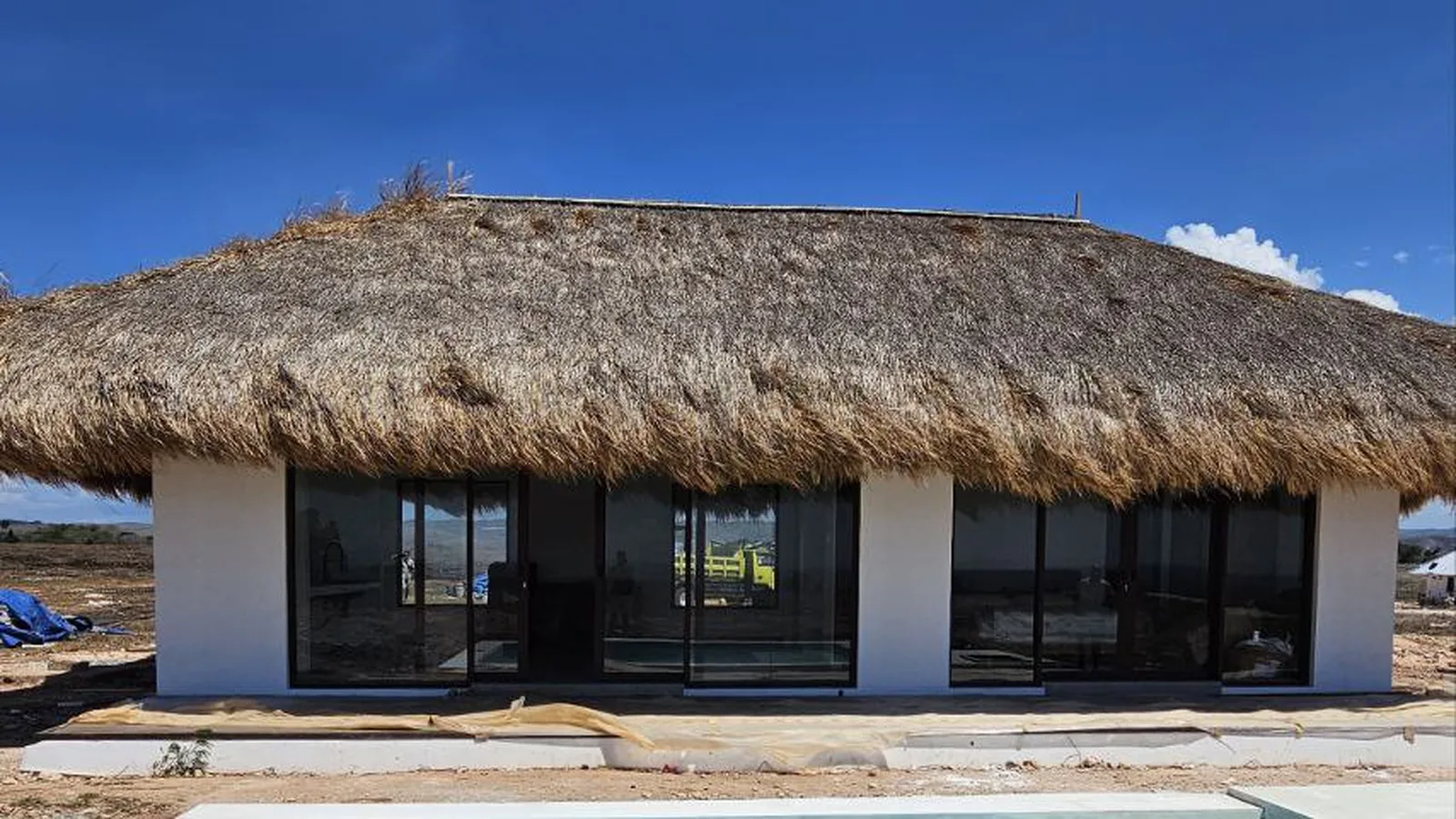
Inside a minimalist glass box perched above Portugal's Alentejo coastline, a man named Stefan, who shed a career in private equity for one in property development, taps a flatscreen. On it, 'Solara Reserve,' a future LEED Platinum community, glows in hyper-realistic render. He speaks of 'biophilic harmony' and 'regenerative living' to a small group of potential investors eyeing off-plan villas that start at €2.8 million. They nod, sipping cold-pressed juice, seeing not just a home but a hedge against a chaotic world—a tangible asset with an impeccable ESG story.
Stefan, tanned and confident in a linen shirt, doesn't talk about ROI. He talks about purpose. He talks about circadian rhythm lighting and chemical-free swimming pools. He talks about how the architecture 'breathes with the landscape.'
Outside the window, beyond the curated illusion of the showroom, the first truckload of concrete rumbles onto the dusty construction site. Its bill of lading includes a certificate for a proprietary 'low-carbon' mix, a document issued by a consulting firm in Dubai with no verifiable testing data. The cement that binds this eco-paradise together is responsible for roughly 8% of all global CO2 emissions. And this particular batch achieves its 'low-carbon' status by incorporating fly ash, a toxic byproduct from coal-fired power plants. The investors inside don't know this. They're captivated by the story. And in the booming market for eco-luxury real estate, the story is what they're really buying.
The Green Gold Rush: Pricing the Eco-Premium
The phenomenon playing out in the Alentejo is part of a global capital migration. The market for so-called sustainable development is no longer a niche for idealists; it's a new frontier of financial arbitrage. The global green building materials market, valued at $255 billion in 2022, is projected by market analysts at Precedence Research to hit $655 billion by 2032, expanding at a compound annual growth rate of 9.9%. This isn't about saving the planet. This is about capitalizing on the perception of saving it.
At the financial core of this boom is the 'green premium'—a quantifiable, often staggering, increase in price for properties brandishing sustainability credentials. A 2021 study from the University of California, Berkeley, found that LEED-certified homes in the US can command a premium of up to 34% over their non-certified equivalents. This premium isn't just about lower utility bills or healthier indoor air; it's the market price of virtue, a tradable commodity for the affluent.
'They're not selling houses; they're selling a new asset class,' explains a candid Singapore-based real estate analyst who tracks high-net-worth investment flows into Southeast Asia. 'The 'eco' part is the ticker symbol. It signals scarcity, quality, and—most importantly—future-proofing against climate guilt and regulation. It's a brilliant piece of financial engineering.'
This new gold rush is being led not by seasoned builders or environmentalists, but by a new tribe of developers like Stefan: ex-finance professionals, former tech entrepreneurs, and marketing executives. They see sustainability not as a moral imperative but as a market inefficiency. They understand branding, capital stacks, and investor psychology far better than they understand soil science or forestry management. They are masters of the spreadsheet, and the 'green premium' is simply another variable to be optimized for maximum yield. They apply the disruption ethos of Silicon Valley to land development, creating Potemkin villages for the 21st century—beautiful facades of ecological harmony engineered to impress the modern-day visiting royalty: the high-net-worth investor. The gritty reality, like the source of the concrete or the fate of the local water table, lies just out of sight.
The Certification Maze: A License to Print Green
For the green premium to hold its value, it requires a seal of approval. This is the role of certification bodies like the U.S. Green Building Council's LEED (Leadership in Energy and Environmental Design) and the UK's BREEAM (Building Research Establishment Environmental Assessment Method). What began as noble efforts to standardize sustainable practices have evolved into multi-million dollar global businesses, creating a complex and often troubling ecosystem of consultants, assessors, and auditors.
An investigation into their business models reveals a fundamental conflict of interest: the developers who seek certification are also the clients paying for it, sometimes tens of thousands of dollars per project. The system incentivizes a 'points-chasing' game, where developers hunt for the cheapest and easiest credits to achieve a high rating, often at the expense of more meaningful, high-cost measures. For example, a developer can earn points under the LEED 'Heat Island Effect' credit simply by painting a roof white or using light-colored paving. This can help offset negative points incurred for, say, destroying a mature tree canopy during site clearance—an action with far greater ecological consequences.
Our analysis of public records and interviews with industry insiders reveals that the verification process for multi-million dollar international projects can be alarmingly superficial. The average review timeline for a 'LEED for Homes' Platinum certification, the highest residential rating, can be completed in as few as 25 business days. Auditors, often based thousands of miles from the construction site, frequently rely solely on documentation—receipts, specifications, photos—provided by the developer's own paid sustainability consultant. On-the-ground, unannounced inspections are rare.
'I left after they approved a resort in the Caribbean,' an anonymous former BREEAM assessor tells me over a secure line. 'The project had cleared a protected mangrove patch, a critical marine nursery. The developer's solution? They made a 'donation' to a local environmental NGO and installed ultra-high-efficiency air conditioners in the villas. They got points for the efficient HVAC and for 'community engagement' through the donation. The mangroves were forgotten. I was told to focus on the submitted paperwork, not on what was bulldozed before the paperwork was filed. The system isn't designed to audit reality; it's designed to audit documents.'
This creates a lucrative loophole where the appearance of sustainability, meticulously documented, becomes more valuable than its actual practice. The certificate, in essence, becomes a license to print green—a tool to monetize an eco-narrative, regardless of its connection to the truth on the ground.
The Timber Trail: A Deforestation Story
At the 'Azure Gardens' development in Costa Rica, a sales agent runs her hand over the rich, chocolate-brown decking surrounding a private plunge pool. 'This is Ipe,' she tells a potential buyer. 'It's one of a kind. We source it from a certified, sustainably-managed family forest in Brazil. It will last a hundred years.' The story is compelling, the wood is beautiful, and the villa costs $3.2 million.
The trail of that Ipe decking, however, tells a different story. It doesn't begin in a quaint family forest but in the chaotic, often violent, frontier of the Brazilian Amazon. Publicly available shipping manifests show the timber for the Azure Gardens project, along with thousands of tons of other Ipe, was exported from the port of Belém. In the last 24 months, this specific port has been flagged in 12 separate instances by INTERPOL's Environmental Crime Programme for its role in facilitating the export of illegally harvested timber.
'The term 'sustainably sourced' has no international legal definition for timber, unlike 'organic' for food,' explains a researcher with the forestry watchdog Earthsight. 'This regulatory void allows for rampant fraud that is virtually impossible for the end-consumer, or even a conscientious developer, to detect.'
The mechanism of fraud is often simple and brutally effective. In a timber yard thousands of miles from Costa Rica, a scene witnessed by our correspondent unfolds routinely: a large pile of freshly cut, uncertified logs from clear-cut land is stacked. Nearby sits a much smaller, legally-required pile of logs bearing official tags from a certified concession. A crane operator methodically picks logs from the illegal pile and mixes them into a container, adding just enough of the certified logs to meet the manifest's quota. The entire container is then sealed and marked 'FSC 100%,' a label from the Forest Stewardship Council meant to be the gold standard of sustainability.
From the port, this laundered timber travels 5,800 miles, passing through free-trade zones where paperwork can be shuffled and origins further obscured. By the time it arrives at the construction site, it comes with a clean chain-of-custody document—a fiction built on a foundation of deforestation. The 'green premium' paid for that Costa Rican villa is, in part, a subsidy for an illicit global supply chain that is devastating the very ecosystems these homes claim to cherish.
The Water Mirage: Draining Paradise Dry
In the sun-bleached landscapes of Baja California, Mexico, a new billboard rises from the desert scrub. It shows an emerald-green golf course bordering an infinity pool that seems to melt into the Sea of Cortez. The development is called 'Agua Viva,' and its marketing materials are filled with phrases like 'water-wise landscaping,' 'greywater recycling systems,' and 'low-flow fixtures.' It promises luxury living in perfect harmony with the fragile desert environment.
This harmony is a carefully constructed mirage. The sales brochure never mentions the concept of 'embodied water'—the immense volume of water consumed not in the villa's daily use, but in its very creation. The production of concrete, steel, glass, and other building materials is an incredibly water-intensive process. Our calculations, based on data from the Water Footprint Network, show that the construction of a single 5,000-square-foot luxury villa like those at Agua Viva requires approximately 1.5 million gallons of embodied water. That is equivalent to the total annual water usage of 40 local residents in the nearby fishing village of El Pescadero.
'They came with promises,' says Javier, a farmer in southern Spain whose family has tended the same olive grove for five generations. He points to a line of brittle, grey trees. 'They told us their resort would be a model of efficiency.' A 200-villa 'eco-resort' with its own championship golf course was built on the plateau above his farm four years ago. 'Before they came, my well was full. Now, the water table has dropped three meters. My trees are dying from the roots up. They have their green fairways, and I have a graveyard.'
The focus on operational water use—the low-flow showerheads and drought-tolerant plants—is a classic misdirection. It's a small, visible gesture of conservation that draws attention away from the much larger, invisible withdrawals. The water used to mix the concrete, cool the machinery, and, most egregiously, fill the dozens of private swimming pools and irrigate the golf course, places an unsustainable burden on local aquifers. These aquifers are often the sole source of water for surrounding communities and ecosystems. For the residents of Agua Viva, 'water-wise' means a slightly less powerful shower. For farmers like Javier, it means the end of a livelihood.
The Carbon Calculus: Fictions of 'Net-Zero'
Perhaps the most potent and abused term in the eco-luxury lexicon is 'net-zero.' It's a powerful marketing claim that suggests a building has no carbon footprint, a guilt-free investment in a heating world. But the calculus behind this claim is often deeply flawed.
The deception lies in a critical distinction: 'operational carbon' versus 'upfront embodied carbon.' Operational carbon is the emissions from a building's day-to-day use—heating, cooling, lighting. This is the 'easy' carbon to deal with. A developer can install a large array of solar panels on the roof and, on paper, offset the building's energy consumption, declaring it 'net-zero operational carbon.'
However, this ignores the elephant in the room: the upfront embodied carbon. This is the massive carbon cost of manufacturing every component of the building, transporting it to the site, and the energy used during construction itself. For a typical luxury villa built with concrete and steel, our analysis shows that upfront embodied carbon can account for over 75% of its total emissions over a 50-year lifespan. Yet, in a review of ten prominent 'net-zero' developments across the globe, nine of them only accounted for operational carbon in their public claims.
'Claiming a concrete-and-steel building is 'net-zero' because you put solar panels on the roof is like claiming a cigarette is healthy because you added a vitamin C filter,' states Dr. Alistair Crane, a materials scientist at Imperial College London. 'It's a dangerously misleading simplification that ignores the vast majority of the impact.'
To patch this enormous hole in their carbon accounting, many developers turn to the opaque world of carbon offsetting. They purchase cheap carbon credits, often from unverifiable forestry projects thousands of miles away. These schemes promise to plant a certain number of trees to 'absorb' the project's emissions. But investigations by groups like Carbon Market Watch have repeatedly shown that many of these projects are failures—the trees are the wrong species, they die from lack of care, or they were planted on land that was never at risk of deforestation in the first place. The developer gets a certificate to wave at investors, while the carbon from their construction remains stubbornly in the atmosphere.
Social Engineering: The 'S' in ESG as Afterthought
Beyond the green-tinted balance sheets and flawed carbon math lies a human cost. The 'S' in ESG—Social—is often treated as a public relations exercise rather than a core component of the development model. Every luxury eco-project comes with a press release celebrating the creation of 'local jobs' and 'community partnerships.' The reality on the ground is frequently a story of displacement, low wages, and profound social stratification.
Consider the 'Montaña Verde' project in Panama, which is transforming a stretch of coastline once used for subsistence farming and fishing into a high-end wellness retreat. Promotional materials promised the creation of '400 sustainable local jobs.' Two years into construction, an analysis of local labor records and interviews with workers tells a different story. Eighty-five percent of the jobs created are temporary construction roles, paying, on average, 20% below the national rate for skilled labor. Key management, engineering, and architectural positions were filled by expatriates from Europe and North America.
'They promised us training in new green building techniques,' says a former construction worker from a nearby village, who asked not to be named. 'What we did was dig foundations and carry materials. The foreign specialists assembled the complex parts. When the building is finished, most of us will be gone. Maybe a few will get jobs cleaning the villas or trimming the gardens.'
This dynamic creates a stark visual and social divide. Just a few hundred meters from the opulent, half-empty villas—each with its own private garden and ocean view—sits the 'staff village.' Here, the local workforce is housed in shared dormitory-style blocks with communal kitchens. This physical separation is a powerful symbol of the social architecture at play: these developments are not integrated communities but exclusive enclaves serviced by a transient, low-wage workforce. The land, once a source of sustenance and cultural identity for a local population, is transformed into a backdrop, a scenic view for a rotating cast of wealthy visitors. Even a well-intentioned project like Eco Beach City in Indonesia faces the challenge of ensuring its economic benefits flow equitably to the local Marapu communities, a task far more complex than designing a solar-powered villa.
| Feature Comparison: Promised vs. Reality | 'Montaña Verde' Promotional Material | On-the-Ground Reality (2 Year Mark) |
|---|---|---|
| Employment | '400 high-skill, permanent local jobs' | ~340 temporary construction jobs, 15 permanent service roles |
| Wages | 'Prosperity and economic empowerment' | Skilled labor paid 20% below national average |
| Community Integration | 'A partnership with local villages' | Displacement of 3 farming families; new security fences block traditional beach access |
| Skill Transfer | 'Training in sustainable construction' | Menial labor roles; skilled positions filled by expatriates |
The Investor's Dilemma: A Bubble in the Eco-System
For the investor sipping juice in the Alentejo showroom, the details of timber manifests and carbon calculus seem remote. Their primary concern is risk and return. But the rampant greenwashing in the eco-luxury sector represents a significant, under-reported financial risk that could leave many of these high-value properties as 'stranded assets.'
The entire 'green premium' is built on a narrative of superior quality and ethical assurance. What happens to that premium—and the underlying asset value—when the narrative is publicly debunked? A cautionary tale emerged in 2022, when an investigation by a team of journalists revealed that a major, award-winning 'eco-resort' in Thailand was built on land that had been illegally cleared within a protected national park. The fallout was immediate. Resales in the development froze. Within 12 months, the few units that did trade hands did so at an estimated 40% discount to their peak prices. The 'eco' label, once a mark of distinction, became a stain of scandal.
This risk is compounded by the looming threat of stricter regulation. As governments in the EU and elsewhere move toward mandatory, science-based reporting on carbon and supply chains, the flimsy, self-certified claims of many current developments won't hold up. A property whose 'net-zero' claim is based on faulty accounting or whose decking is traced to illegal logging could see its value plummet when new disclosure laws come into effect.
Financial Comparison: What are you buying?
- Amsterdam, 'Houthaven' District: A 150 sq. meter, 3-bedroom apartment built to government-mandated and independently audited 'Energy Neutral' standards costs approximately €1.1 million.
- Costa Rica, 'Azure Gardens' Development: A comparable-sized 'eco-villa' with a 'net-zero' claim validated by a for-profit US consultancy sells for $2.5 million (€2.3 million).
This stark price difference raises the critical question for an investor: Is the extra €1.2 million buying genuinely superior ecology, or is it buying a more aggressive marketing campaign and a higher developer margin built on a precarious foundation?
'Look, my fund has exposure to several of these projects,' a London-based fund manager admits over lunch, defending his portfolio. 'The financial model is sound. The demand is there.' When pressed on whether he personally audited the timber supply chain or the carbon offset verification for a specific project his fund backs, he shifts uncomfortably. 'We rely on the third-party certifications. That's their job. Our job is to assess the demand curve.' It's a common refrain: a willful ignorance that protects the financial model, at least for now.
The Soil and the Soul: In Search of an Alternative
It's easy to become cynical. Yet, beyond the Potemkin villages of mainstream eco-luxury, a different model is quietly taking root. It's smaller, slower, and far less profitable, but its claims are grounded in the earth itself.
In Italy's Apennine mountains, the 'Terraviva Cooperative' offers a stark contrast. It is not a resort, but a community of 12 homes. There was no glossy showroom, only a series of workshops with future residents. Instead of importing exotic materials, they prioritized radical localism. The walls are made of rammed earth, using soil excavated directly from the home sites. The structural beams are local chestnut, milled at a family-owned sawmill 20 kilometers away. In total, 90% of the building materials were sourced from within a 50-kilometer radius.
The entire project, including the land, cost €4 million. It wasn't 'net-zero' in the fashionable sense, but its upfront embodied carbon is a fraction of a conventional build. Its energy and water use, audited by the engineering department of a local university, not a for-profit certifier, is 80% lower than a standard Italian home. The philosophy here is not high-tech optimization but elegant sufficiency.
I meet the project's architect, Elena Rossi, not in an office, but in the community's vegetable garden. She has dirt under her fingernails. She points to a pipe emerging from the ground near a bed of tomatoes. 'That's from the wastewater treatment system,' she explains. 'It's a multi-stage reed bed filter. The treated blackwater provides nutrients for this non-edible biomass plot, which we then compost.' The buildings are designed not just to minimize harm, but to actively participate in the life of the landscape. Waste becomes food. The houses are not sealed objects dropped onto the land, but porous systems in dialogue with it.
There is no 'green premium' here because the homes are not speculative assets to be flipped. They are simply places to live. The luxury is not in the branding, but in the integrity of the process—the quiet confidence that comes from knowing exactly where every component came from, and where it will eventually go.
The ultimate luxury is not a villa with a green certificate, but the clarity to know what that certificate truly cost. As the market for 'eco-luxury' swells, the most critical investment is not in property, but in due diligence. It's the only way to find the solid ground beneath our feet, before we discover the green veneer has been covering a hollow core all along.