The Accidental Town Square: An Island's New Anchor
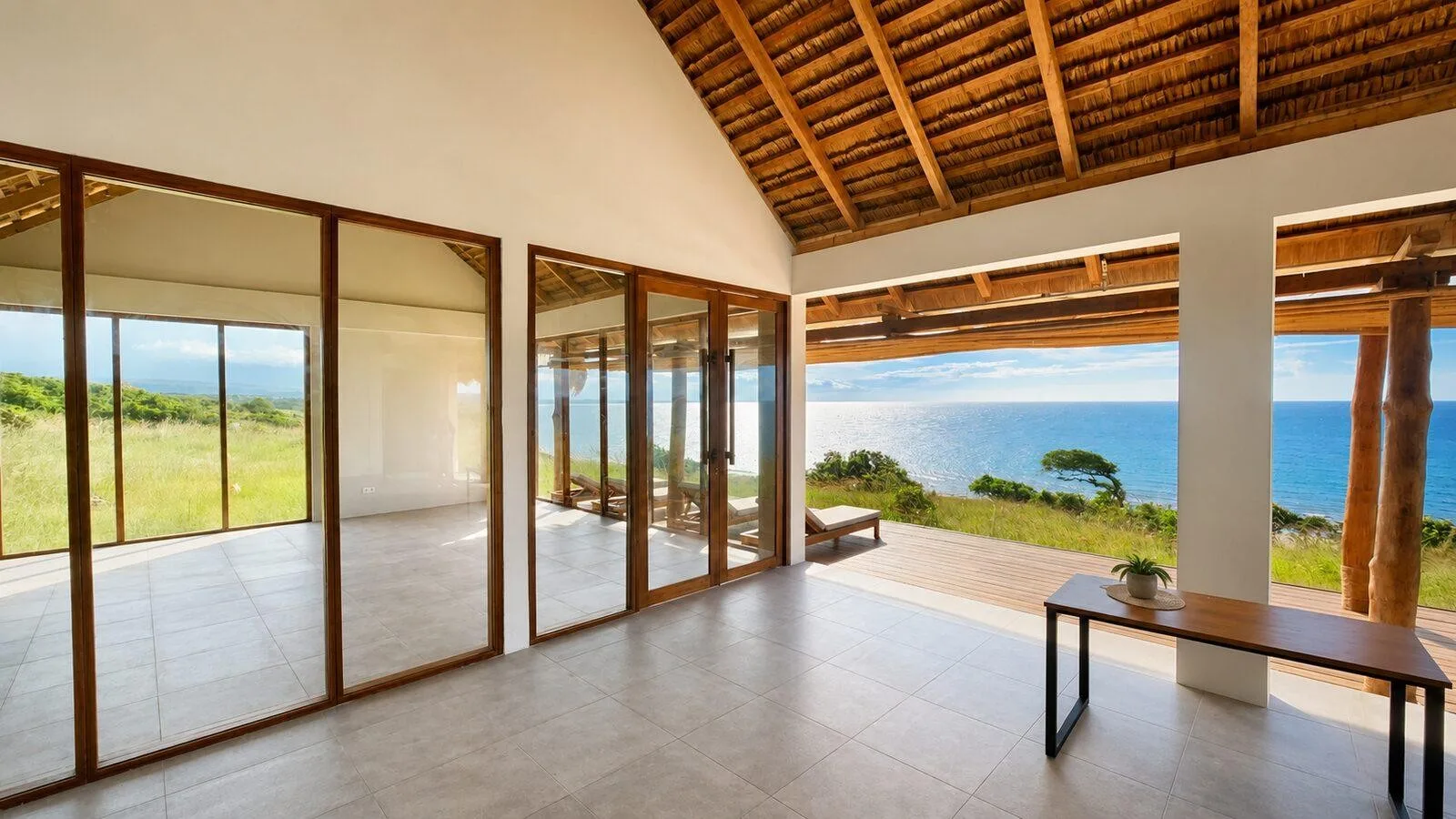
The generator sputtered, coughed twice like a dying buffalo, and finally gave up. The sudden silence was deeper than the darkness that swallowed the bamboo pavilion whole. On a dozen laptop screens, the faces of clients in London, New York, and Berlin froze in a gallery of digital confusion—a PowerPoint slide held mid-transition, a mouth agape mid-pitch. A collective, low groan rippled through the humid air, the universal sound of a dropped connection.
But Maria Reyes didn’t flinch. She was already moving through the gloom with the practiced economy of someone who has choreographed this dance a thousand times. She lit a citronella coil, its sharp, clean scent cutting through the thick smell of impending rain. With a firm kick, she engaged the switch on a humming bank of batteries near the server rack. A moment later, a string of warm LED bulbs flickered to life, casting a gentle glow on the concentrated faces. The Wi-Fi router rebooted. A second groan, this one of relief, went through the room.
“The grid giveth, and the grid taketh away,” she announced to no one in particular, her voice laced with the dry amusement that has become my default setting after eight years in Southeast Asia. “But the sun? The sun is reliable.”
This is Port Barton, a fishing village in the Philippines that, until recently, was known more for its jellyfish stings than its upload speeds. And this is Koneksyon, Maria’s coworking space. The solar-powered backup system wasn’t a luxury amenity listed on a glossy brochure. It was a tactical necessity, an expensive, hard-won piece of infrastructure she installed herself, designed not for profit, but for survival against the island’s fickle state-run power grid. It’s what allows a Dutch programmer to bill a client in Amsterdam while a fisherman’s son downloads his university application form two tables away. It’s the engine of this strange, new, accidental town square.
The Anchor in the Stream
For the past decade, the narrative around remote work in the tropics has been dominated by a certain kind of velocity. It’s a story of motion, of a transient “laptop class” breezing through places like Bali or Tulum, treating them as interchangeable backdrops for a life lived on Instagram. The coworking spaces in these mega-hubs are often vast and impersonal, cathedrals of productivity with hundreds of members, where the primary social function is networking for the next venture, the next destination. They are waypoints, not destinations. Rest stops on the digital highway.
But something else has been quietly taking root in the smaller, dustier places—the fishing villages and forgotten surf towns from Bocas del Toro in Panama to Hiriketiya in Sri Lanka. Here, a different model is emerging. Call them micro-hubs. These are smaller, slower, and profoundly more integrated spaces. They are less about serving a fleeting army of 25-year-old content creators and more about anchoring a community of 30- and 40-somethings, often with families in tow, who are less interested in perpetual motion and more in what has been termed “slow travel” or, more accurately, “just living.”
In these places, the coworking space ceases to be a simple utility—an office with a view. It becomes, by necessity, the town’s most reliable piece of public infrastructure.
Let’s look at the numbers. The average coworking space in Bali’s Canggu has over 150 members, a churning sea of faces. The emerging micro-hubs in places like Palawan or coastal Colombia average between 15 and 30 desks. The scale is intimate, and that intimacy changes everything. The relationships forged are not transactional; they are foundational. “I came here for three months, four years ago,” says Alex, a 42-year-old user experience designer from Toronto, gesturing around Maria’s pavilion. “Now, I probably only work here ten hours a week. My home internet is fine. I come here for this,” he says, pointing toward the main table where a local guide is sketching a map for a new German arrival, and two women—one a visiting lawyer, the other a local bakery owner—are comparing notes on school fees. “This is my living room. It’s how I know what’s actually going on in the village, who needs help, whose boat broke down, which kid won the scholarship. It’s the pulse.”
These spaces are not streams; they are anchors dropped into the stream. They are becoming the fixed point around which a new, hybrid form of community life is beginning to organize itself. They are the 21st-century equivalent of the village well, the post office, or the old banyan tree that once served as the natural meeting point. Except this one has a 200 Mbps fiber connection and takes monthly payments via Stripe.
The Accidental Mayor
Every one of these anchors has an anchor-keeper. Often, it’s not a foreign investor spotting a gap in the market, but a local or a repatriated native who becomes a kind of reluctant civic leader. Take Luis Varga in Bocas del Toro, Panama. Wiry, perpetually sun-browned, and armed with a degree in systems engineering from a university in Bogotá he never thought he’d use back home, Luis is the founder of ‘Nativo,’ a coworking space built on stilts over the turquoise water.
When I ask him if he always planned to be an entrepreneur, he lets out a short, sharp laugh. “I planned to work for a bank in the city. My parents saved for years for my education. Coming back here to run a guesthouse felt like a failure.” But the island pulled him back. The problem was, the same issues that drove him away persisted: isolation, lack of opportunity, and internet that timed out if a cloud passed over the sun. “I saw my cousins, the smart ones, all leaving. The brain drain was real. The only people coming in were tourists who left their money with foreign-owned hotels. There was no exchange.”
His idea was simple and, to his family, insane. He wanted to build a place that would attract a different kind of foreigner—one who stayed longer, shared skills, and needed the one thing he knew how to provide: a stable connection to the outside world. The problem was the nearest fiber optic junction was 1.5 kilometers away, across a mangrove swamp and a channel used by local water taxis. The national telecom company quoted him an astronomical figure to run a line. So, Luis did it himself. He poured his entire life savings—$75,000 scraped together from his own funds, a loan from his aunt, and what he sheepishly calls “some very patient friends”—into buying the cable and hiring a local crew to lay it. For three months, they waded through chest-deep water, strapping the thick black cable to mangrove roots and burying it under the seabed.
“My father came down to the dock every day for a week,” Luis recalls, leaning against a weathered piling. “He’d just shake his head. ‘You’re burying your inheritance in the mud,’ he told me. He thought I was building some clubhouse for lazy gringos.” But when the switch was flipped, and Nativo had the fastest, most reliable internet in the entire archipelago, something shifted. It wasn’t just foreigners who showed up. It was local business owners wanting to create online booking systems. It was students needing to do research. It was Luis’s own cousin, who had been working remotely for a company in Panama City from a cramped apartment, who became his first official member.
“I didn’t want to build a business,” Luis tells me, his gaze fixed on the horizon. “I wanted to build the place I wished existed when I was growing up here—a window to the world that didn’t require leaving home.” He had set out to solve a technical problem and ended up becoming the accidental mayor of a burgeoning global village.
The Infrastructure of Trust
In developed cities, we take infrastructure for granted. It’s the invisible architecture of our lives. You flip a switch, light appears. You open a tap, water flows. You connect to Wi-Fi, the world is there. In many of these remote tropical outposts, infrastructure is a daily, conscious struggle. And the person who solves that struggle doesn’t just earn money; they earn a unique form of social capital. They earn trust.
The story of these micro-hubs is a story of technical ingenuity born of desperation. Before Elon Musk’s Starlink satellite constellation became a viable, if sometimes politically contentious, option, getting reliable internet was a feat of guerrilla engineering. I’ve seen setups that would make a Silicon Valley network admin weep: a chain of five signal boosters daisy-chained up a coconut palm, a powerful directional antenna bolted to a fishing boat for better line-of-sight, a shared community server housed in a modified chest freezer to protect it from the humidity and salt air.
Solving the internet and power problem transforms a coworking space from a lifestyle accessory into an essential service. It becomes the most dependable place in town. In Siargao, another Philippine island rebuilding after a devastating typhoon, the founder of one hub told me that during the long months of recovery, his space, powered by a huge solar array and a Starlink dish, became the unofficial command center for the entire community. “We were the only place with light and a connection. People came here to charge their phones, to let their families know they were alive, to coordinate aid deliveries.”
This role doesn’t vanish when the crisis passes. The trust remains. That same space in Siargao saw its monthly bill for a Starlink Business plan drop from around $500 in early 2023 to $250 by 2024. That price adjustment, a direct result of Starlink expanding its service footprint, was a windfall. But instead of pocketing the difference, the owner used the savings to offer free evening access, from 6 pm to 9 pm, to local high school students. The place is now packed every night with teenagers doing homework, a quiet hum of studiousness replacing the clatter of keyboards from the day’s remote workers. This simple act cemented the hub’s status as a community asset, not just a foreign enclave. It’s a recurring theme: tech support as community outreach. On a sweltering Tuesday in Sri Lanka, I watched a visiting Israeli software engineer, a nomad who had been in town for six months, hold an impromptu “community tech day.” For four hours, he sat at a large communal table as a steady stream of villagers brought him their cracked phones, virus-riddled laptops, and sputtering tablets. He fixed what he could, offered advice on what he couldn't, all for the price of a cup of tea. The event was organized and hosted by the coworking space. It wasn't about charity; it was about symbiosis. It was infrastructure—both technical and social—being built, one repaired device at a time.
The Third Place, Redefined
The American sociologist Ray Oldenburg coined the term “third place” in 1989 to describe the crucial anchors of community life that exist outside the two primary environments of home (the first place) and the workplace (the second place). These are the cafés, pubs, libraries, and parks where people gather, connect, and form the bonds that constitute a society.
In many of the remote, developing towns where these micro-hubs are flourishing, traditional third places are scarce. There might be a local bar, but it’s often gender-segregated. There may be a religious building, but it’s not secular. Public parks or community halls are rare luxuries. Into this vacuum steps the coworking space, which doesn’t just become a third place; it becomes the third place, a hyper-functional hybrid that serves multiple roles at once. It’s the post office for receiving packages, the café for a decent cup of coffee, the library for a quiet corner, the town hall for meetings, and the village square for gossip—all powered by a monthly subscription model.
This shift in function is reflected in why people join. A survey of 50 members at a space in southern Sri Lanka was revealing. When asked their primary reason for membership, the results were not what you’d expect.
| Reason for Membership | Percentage of Respondents |
|---|---|
| Community & Events | 65% |
| Reliable Internet | 45% |
| Quiet Workspace | 30% |
| Networking | 20% |
Note: Respondents could choose multiple options.
Community trumped connectivity. People weren’t just buying Wi-Fi; they were buying a social life. The most successful spaces understand this and program their offerings accordingly. The calendar isn’t just filled with “LinkedIn for Freelancers” workshops. It’s potluck dinners, beach clean-ups, language exchanges, and movie nights. One Thursday evening, I found myself at one such potluck. The setup was simple: a long table under a canopy of stars. A Belgian graphic designer who specialized in branding for fintech startups was deep in conversation with a local fisherman named Wayan. They weren't talking about work. They were arguing, with much laughter, over the best way to prepare grilled snapper. The designer had brought a craft beer she’d had shipped from home; Wayan had brought the fish, caught that afternoon. Later, the fisherman’s daughter, a teenager, shyly showed the designer an illustration she had drawn on an old Samsung tablet. The designer’s eyes lit up, and she spent the next twenty minutes showing the girl a few tricks in a free drawing app. It was a scene of casual, unforced exchange, a world away from the sterile networking events of a city high-rise. It was the third place, redefined for a globalized world, smelling faintly of grilled fish, salt, and citronella.
Symbiosis and Skill-Swaps
For years, the economic argument for digital nomadism has been simplistic: a high-earning foreigner arrives, spends their dollars or euros on rent, food, and mojitos, and the local economy benefits. This is true, but it’s also the shallowest and most colonial version of the exchange. It reduces the local population to service providers and the nomads to walking ATMs. The real, durable value being created in these smaller hubs is far more symbiotic and is centered on the exchange of skills, not just cash.
These coworking spaces act as the perfect crucible for this exchange. They are neutral territory where two worlds can meet on equal footing. Unlike a resort, where the power dynamic is rigidly defined, or a local home, which can be intimidating for both sides to enter, the hub is a space of professional peerage. A desk is a desk, whether you’re coding a blockchain application or managing your family’s three-room guesthouse.
Some hubs are formalizing this exchange. A space in coastal Colombia, grappling with how to make itself more accessible to the local community, introduced a ‘Community Contribution’ membership tier. The standard monthly fee is $200. But if a member commits to ten hours of verifiable skill-sharing per month—tutoring local kids in English, running a workshop on basic accounting, helping a craftsman photograph his goods for an Etsy shop—the fee is reduced by 40% to $120. It’s a brilliant model that quantifies the value of social contribution.
More often, the exchange is organic. I met the matriarch of a family that runs a small warung, a simple roadside restaurant, just outside a popular surf break in Indonesia. For years, their business was entirely dependent on foot traffic. Then her son, Putu, started hanging around the local coworking space, initially just to use the fast internet for his video games. He got to talking with some of the members and ended up joining a free, informal workshop on social media marketing run by a German member. He learned how to create an Instagram profile, how to take appealing photos of his mother’s food, and how to use WhatsApp for business to take pre-orders. Within six months, their online orders, mostly from people in nearby villas who had never walked past their warung, had increased by 300%. They had to hire two more people from the village just to handle the deliveries. “Before, we wait for people,” his mother told me, beaming. “Now, the phone tells us they are coming.” The coworking space hadn't just given her son a place to play games; it had given her family a new lifeline.
The New Colonialism or a Fairer Exchange?
It’s impossible to ignore the undercurrent of anxiety that flows beneath this utopian vision of symbiotic exchange. The arrival of a cohort of relatively wealthy, highly mobile foreigners into a small, often economically fragile community is a fraught event. It’s a story as old as the first trading posts established on these same shores centuries ago. Is this a new, more insidious form of colonialism, cloaked in the language of collaboration and community? Or is it a genuinely fairer model of global interaction?
The truth, as always, is messy and lies somewhere in between. The most immediate and visceral impact is on the cost of living. The data is stark. In Santa Teresa, a once-sleepy surf town in Costa Rica, the proliferation of remote workers has been directly correlated with a staggering rise in housing costs. The average monthly rent for a simple two-bedroom house has exploded by over 70% in the last five years, from roughly $800 to over $1,350, pushing many local families further inland, away from the beach their parents and grandparents had lived on for generations.
Food prices follow. When a newcomer is willing to pay $5 for an artisanal sourdough loaf, the local baker has little incentive to keep selling his traditional bread for 50 cents. This “gringo pricing” effect creates a two-tiered economy that can breed resentment. The coworking hubs can either exacerbate this division or actively work to mitigate it.
A key variable is ownership. A foreign-owned hub, particularly one funded by absentee investors, is fundamentally an extractive enterprise. Profits are repatriated, and the incentive is to cater exclusively to the highest-paying foreign clientele, creating a classic expat bubble. A locally-owned hub, like Maria’s in Port Barton or Luis’s in Bocas del Toro, has a different set of incentives. Their families live there. Their reputation in the community is paramount. They are more likely to create sliding-scale pricing, host inclusive events, and act as a bridge between the two communities rather than a wall.
Even so, navigating the cultural sensitivities is a constant, delicate balancing act. One afternoon, I sat with a village elder on the porch of his home, a simple wooden structure just a stone’s throw from a new, glass-fronted coworking space. He had a look on his face I’ve seen many times—a mixture of bemusement, suspicion, and reluctant curiosity. He watched as a young woman with a laptop bag hurried past.
“For fifty years, the sea gives us fish. Then the tourists come, and they give us dollars. Now this new wave…” he paused, searching for the right words. “They give us Wi-Fi. I am still deciding if we can eat Wi-Fi.”
His words hung in the hot, still air. It’s the central question, and the answer is not yet clear.
The Zoning Grey Zone
Beneath the social and economic tensions lies a more prosaic, but equally threatening, challenge: the law. In the bureaucratic ledgers of most developing nations, the concept of a “coworking space” simply does not exist. This legal ambiguity forces founders into a precarious grey zone, operating on the fringes of municipal zoning and national labor laws.
Most hubs are registered under ill-fitting licenses—as a cafe, an office rental business, a language school, or simply a “consultancy.” This a-legal status makes them intensely vulnerable. Their entire existence can be threatened by a single complaint from a disgruntled neighbor, a sudden visit from a zealous tax inspector, or a shift in the local political winds. I spoke with a founder in Thailand who, for two years, ran a successful space on a small island. He operated under a simple office rental license. But as the space grew, it attracted the attention of authorities. He was informed that because he provided desks, internet, and coffee, he was technically an employer. He was suddenly facing the requirement to adhere to the rigid 4:1 Thai-to-foreign employee ratio, a law designed for large manufacturing companies, not a 20-desk work hub. Unable to comply, he was forced to shut down.
This precarity breeds a specific kind of low-grade, constant anxiety. One founder I know in Indonesia, a woman who has successfully run her space for five years, half-jokingly described her “go-bag” to me. It’s not filled with emergency supplies, but with a meticulously organized portfolio of legal documents: business licenses, tax receipts, land certificates, and a letter of support from the local village chief. She has the personal mobile number of the regional police chief on speed dial. “It’s the cost of doing business on the frontier,” she said with a shrug. “You have to be more prepared, more connected, and a little bit luckier than everyone else.” This isn’t the relaxed, carefree island life of the marketing brochures. It’s the high-wire act of a pioneer, constantly scanning the horizon not just for storms, but for men in crisp uniforms carrying clipboards.
When the Secret Gets Out
Here lies the final, cruel paradox for these accidental town squares. The very qualities that make a location attractive to the first wave of pioneers—its quietness, its authenticity, its affordability—are inherently destroyed by the attention they bring. The micro-hub, in its quest to make a place viable for long-term stays, often becomes the agent of its own demise.
It’s a predictable lifecycle. A space opens, word gets out on niche blogs and closed Telegram groups. A few dozen adventurous souls arrive. The place gets a mention in a mainstream travel magazine’s ‘Top Remote Work Destinations’ list. And then the floodgates open. The data shows it clearly. After one such feature, Skyscanner reported that flight searches to Siargao Island’s airport (IAO) increased by a staggering 250% year-over-year. The secret is out.
Suddenly, the original founder is no longer the only game in town. Larger, better-funded players arrive, drawn by the proven market. They open slicker, bigger coworking spaces. Developers who once wouldn’t have given the place a second glance are now flying in, snapping up beachfront land for luxury villa complexes. The founder of the original hub, the one who laid the groundwork and built the community, is now faced with a Frankenstein’s monster of their own creation. They are forced into a new role: guardian of the original ethos.
I witnessed this firsthand at a tense town hall meeting hosted by a coworking space in a location on the cusp of becoming ‘the next big thing.’ The founder, a woman in her late 30s who had started the space five years prior, stood at the front of the room, attempting to mediate. On one side sat a group of newly arrived developers from Jakarta, their sharp suits looking absurdly out of place. On the other side sat a group of local farmers, their faces etched with worry. The developers were proposing a 50-villa complex with a desalination plant. The farmers were terrified it would deplete and salinate the water table they relied on for their crops. The coworking space, once a quiet haven, had become the battleground for the soul of the island. The founder, who just wanted to create a nice place to work, was now a de facto urban planner, environmental advocate, and conflict negotiator.
Her success had brought the world to her door. Now she had to figure out how to stop it from breaking the door down.
We love to romanticize the lone wanderer, the unattached soul drifting through paradise. But the real story of this moment isn't about the people who pass through. It’s about the places they—and the locals who welcome them—are building together. These hubs are a bet on permanence in a culture of impermanence. The ultimate test for these new banyan trees is not whether the nomads stay, but whether the roots they put down are strong enough to hold the community together when the next, bigger wave of ‘progress’ inevitably arrives on the tide.